


Page 47 - DINOSOUR ATLAS
P. 47
EuropE’S fIrST DINoSAurS
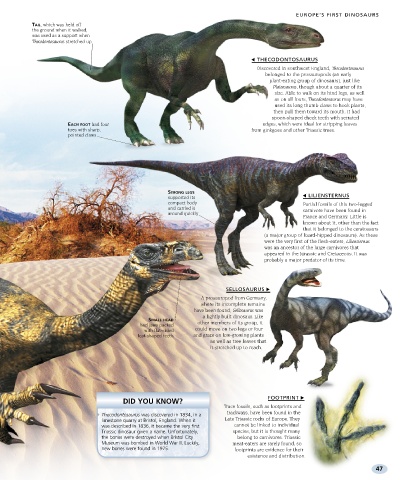
            taiL, which was held off
            the ground when it walked,
            was used as a support when
            Thecodontosaurus stretched up

                                                                                           , THECoDoNToSAuruS
                                                                                            Discovered in southwest England, Thecodontosaurus
                                                                                               belonged to the prosauropods (an early
                                                                                                 plant-eating group of dinosaurs), just like
                                                                                                  Plateosaurus, though about a quarter of its
                                                                                                   size. Able to walk on its hind legs, as well
                                                                                                   as on all fours, Thecodontosaurus may have
                                                                                                   used its long thumb claws to hook plants,
                                                                                                  then pull them toward its mouth. It had
                                                                                                  spoon-shaped cheek teeth with serrated
                         each foot had four                                                    edges, which were ideal for stripping leaves
                         toes with sharp,                                                  from ginkgoes and other Triassic trees.
                         pointed claws


                                                             strong Legs
                                                             supported its                                   , LILIENSTErNuS
                                                             compact body                                    Partial fossils of this two-legged
                                                             and carried it                                  carnivore have been found in
                                                             around quickly
                                                                                                             France and Germany. Little is
                                                                                                             known about it, other than the fact
                                                                                                             that it belonged to the ceratosaurs
                                                                                               (a major group of lizard-hipped dinosaurs). As these
                                                                                               were the very first of the flesh-eaters, Liliensternus
                                                                                               was an ancestor of the large carnivores that
                                                                                               appeared in the Jurassic and Cretaceous. It was
                                                                                               probably a major predator of its time.


                                                                                  SELLoSAuruS .
                                                                         A prosauropod from Germany,
                                                                         where its incomplete remains
                                                                      have been found, Sellosaurus was
                                                                         a lightly built dinosaur. Like
                                                      smaLL head
                                                   had jaws packed     other members of its group, it
                                                    with flat-sided     could move on two legs or four
                                                  leaf-shaped teeth   and graze on low-growing plants
                                                                            as well as tree leaves that
                                                                            it stretched up to reach.


                                             did you know?                                      fooTprINT .
                                                                                 Trace fossils, such as footprints and
                                    . Thecodontosaurus was discovered in 1834, in a   trackways, have been found in the
                                     limestone quarry at Bristol, England. When it   Late Triassic rocks of Europe. They
                                     was described in 1836, it became the very first   cannot be linked to individual
                                     Triassic dinosaur given a name. Unfortunately,   species, but it is thought many
                                     the bones were destroyed when Bristol City       belong to carnivores. Triassic
                                     Museum was bombed in World War II. Luckily,    meat-eaters are rarely found, so
                                     new bones were found in 1975.                   footprints are evidence for their
                                                                                         existence and distribution.
                                                                                                                                       47

