


Page 143 - Euclid's Elements of Geometry
P. 143
ST	EW      eþ.


                                                                                            ELEMENTS BOOK 5


            ὑπερέχει καὶ τὰ Η, Θ, Κ τῶν Λ, Μ, Ν, καὶ εἰ ἴσον, ἴσα, καὶ and if (G is) less (than L then H is also) less (than M,
            εἰ ἔλαττον, ἔλαττονα. καί ἐστι τὸ μὲν Η καὶ τὰ Η, Θ, Κ  and K than N) [Def. 5.5]. And, hence, if G exceeds L
            τοῦ Α καὶ τῶν Α, Γ, Ε ἰσάκις πολλαπλάσια, ἐπειδήπερ ἐὰν then G, H, K also exceed L, M, N, and if (G is) equal
            ᾖ ὁποσαοῦν μεγέθη ὁποσωνοῦν μεγεθῶν ἴσων τὸ πλῆθος (to L then G, H, K are also) equal (to L, M, N) and
            ἕκαστον ἑκάστου ἰσάκις πολλαπλάσιον, ὁσαπλάσιόν ἐστιν if (G is) less (than L then G, H, K are also) less (than
            ἓν τῶν μεγεθῶν ἑνός, τοσαυταπλάσια ἔσται καὶ τὰ πάντα L, M, N). And G and G, H, K are equal multiples of
            τῶν πάντων. διὰ τὰ αὐτὰ δὴ καὶ τὸ Λ καὶ τὰ Λ, Μ, Ν τοῦ A and A, C, E (respectively), inasmuch as if there are
            Β καὶ τῶν Β, Δ, Ζ ἰσάκις ἐστὶ πολλαπλάσια· ἔστιν ἄρα ὡς  any number of magnitudes whatsoever (which are) equal
            τὸ Α πρὸς τὸ Β, οὕτως τὰ Α, Γ, Ε πρὸς τὰ Β, Δ, Ζ.   multiples, respectively, of some (other) magnitudes, of
               ᾿Εὰν ἄρα ᾖ ὁποσαοῦν μεγέθη ἀνάλογον, ἔσται ὡς ἓν equal number (to them), then as many times as one of the
            τῶν ἡγουμένων πρὸς ἓν τῶν ἑπομένων, οὕτως ἅπαντα τὰ  (first) magnitudes is (divisible) by one (of the second),
            ἡγούμενα πρὸς ἅπαντα τὰ ἑπόμενα· ὅπερ ἔδει δεῖξαι.  so many times will all (of the first magnitudes) also (be
                                                                divisible) by all (of the second) [Prop. 5.1]. So, for the
                                                                same (reasons), L and L, M, N are also equal multiples
                                                                of B and B, D, F (respectively). Thus, as A is to B, so
                                    igþ                         ever (which are) proportional then as one of the leading
                                                                A, C, E (are) to B, D, F (respectively).
                                                                   Thus, if there are any number of magnitudes whatso-
                                                                (magnitudes is) to one of the following, so will all of the
                                                                leading (magnitudes) be to all of the following. (Which
                                                                is) the very thing it was required to show.
                                                          ′
                                                                                                    ′
                                                    ′
                                                                                                ′
            †  In modern notation, this proposition reads that if α : α :: β : β :: γ : γ etc. then α : α :: (α + β + γ + · · · ) : (α + β + γ + · · · ).
                                                                                             ′
                                                               ′
                                                                          ′
                                                                                Proposition 13
                                      .
                                                                                                †
               ᾿Εὰν πρῶτον πρὸς δεύτερον τὸν αὐτὸν ἒχῃ λόγον καὶ   If a first (magnitude) has the same ratio to a second
            τρίτον πρὸς τέταρτον, τρίτον δὲ πρὸς τέταρτον μείζονα that a third (has) to a fourth, and the third (magnitude)
            λόγον ἔχῃ ἢ πέμπτον πρὸς ἕκτον, καὶ πρῶτον πρὸς δεύτερον has a greater ratio to the fourth than a fifth (has) to a
            μείζονα λόγον ἕξει ἢ πέμπτον πρὸς ἕκτον.            sixth, then the first (magnitude) will also have a greater
                                                                ratio to the second than the fifth (has) to the sixth.
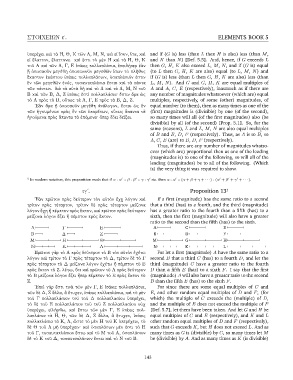
              Α            Γ               Ε                     A            C               E
              Β            ∆               Ζ                     B            D               F
              Μ            Η               Θ                     M            G               H
              Ν            Κ               Λ                     N            K               L
               Πρῶτον γὰρ τὸ Α πρὸς δεύτερον τὸ Β τὸν αὐτὸν ἐχέτω  For let a first (magnitude) A have the same ratio to a
            λόγον καὶ τρίτον τὸ Γ πρὸς τέταρτον τὸ Δ, τρίτον δὲ τὸ Γ  second B that a third C (has) to a fourth D, and let the
            πρὸς τέταρτον τὸ Δ μείζονα λόγον ἐχέτω ἢ πέμπτον τὸ Ε  third (magnitude) C have a greater ratio to the fourth
            πρὸς ἕκτον τὸ Ζ. λέγω, ὅτι καὶ πρῶτον τὸ Α πρὸς δεύτερον D than a fifth E (has) to a sixth F. I say that the first
            τὸ Β μείζονα λόγον ἕξει ἤπερ πέμπτον τὸ Ε πρὸς ἕκτον τὸ  (magnitude) A will also have a greater ratio to the second
            Ζ.                                                  B than the fifth E (has) to the sixth F.
               ᾿Επεὶ γὰρ ἔστι τινὰ τῶν μὲν Γ, Ε ἰσάκις πολλαπλάσια,  For since there are some equal multiples of C and
            τῶν δὲ Δ, Ζ ἄλλα, ἃ ἔτυχεν, ἰσάκις πολλαπλάσια, καὶ τὸ μὲν E, and other random equal multiples of D and F, (for
            τοῦ Γ πολλαπλάσιον τοῦ τοῦ Δ πολλαπλασίου ὑπερέχει, which) the multiple of C exceeds the (multiple) of D,
            τὸ δὲ τοῦ Ε πολλαπλάσιον τοῦ τοῦ Ζ πολλαπλασίου οὐχ and the multiple of E does not exceed the multiple of F
            ὑπερέχει, εἰλήφθω, καὶ ἔστω τῶν μὲν Γ, Ε ἰσάκις πολ- [Def. 5.7], let them have been taken. And let G and H be
            λαπλάσια τὰ Η, Θ, τῶν δὲ Δ, Ζ ἄλλα, ἃ ἔτυχεν, ἰσάκις equal multiples of C and E (respectively), and K and L
            πολλαπλάσια τὰ Κ, Λ, ὥστε τὸ μὲν Η τοῦ Κ ὑπερέχειν, τὸ  other random equal multiples of D and F (respectively),
            δὲ Θ τοῦ Λ μὴ ὑπερέχειν· καὶ ὁσαπλάσιον μέν ἐστι τὸ Η such that G exceeds K, but H does not exceed L. And as
            τοῦ Γ, τοσαυταπλάσιον ἔστω καὶ τὸ Μ τοῦ Α, ὁσαπλάσιον many times as G is (divisible) by C, so many times let M
            δὲ τὸ Κ τοῦ Δ, τοσαυταπλάσιον ἔστω καὶ τὸ Ν τοῦ Β.  be (divisible) by A. And as many times as K (is divisible)


                                                             143

