


Page 141 - Euclid's Elements of Geometry
P. 141
ST	EW      eþ.


                                                                                            ELEMENTS BOOK 5


            ἔχει, ἐκεῖνο ἔλαττόν ἐστιν.                         (the) greater. And that (magnitude) to which the latter
                                                                (magnitude) has a greater ratio is (the) lesser.
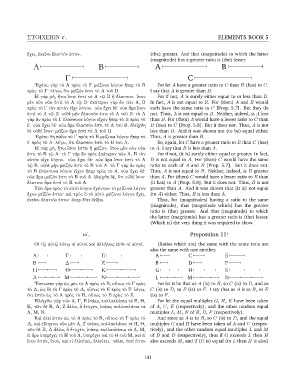
               Α                          Β                       A                           B

                            Γ                                                   C
               ᾿Εχέτω γὰρ τὸ Α πρὸς τὸ Γ μείζονα λόγον ἤπερ τὸ Β   For let A have a greater ratio to C than B (has) to C.
            πρὸς τὸ Γ· λέγω, ὅτι μεῖζόν ἐστι τὸ Α τοῦ Β.        I say that A is greater than B.
               Εἰ γὰρ μή, ἤτοι ἴσον ἐστὶ τὸ Α τῷ Β ἢ ἔλασσον. ἴσον  For if not, A is surely either equal to or less than B.
            μὲν οὖν οὔκ ἐστὶ τὸ Α τῷ Β· ἑκάτερον γὰρ ἂν τῶν Α, Β  In fact, A is not equal to B. For (then) A and B would
            πρὸς τὸ Γ τὸν αὐτὸν εἶχε λόγον. οὐκ ἔχει δέ· οὐκ ἄρα ἴσον each have the same ratio to C [Prop. 5.7]. But they do
            ἐστὶ τὸ Α τῷ Β. οὐδὲ μὴν ἔλασσόν ἐστι τὸ Α τοῦ Β· τὸ Α not. Thus, A is not equal to B. Neither, indeed, is A less
            γὰρ ἂν πρὸς τὸ Γ ἐλάσσονα λόγον εἶχεν ἤπερ τὸ Β πρὸς τὸ  than B. For (then) A would have a lesser ratio to C than
            Γ. οὐκ ἔχει δέ· οὐκ ἄρα ἔλασσόν ἐστι τὸ Α τοῦ Β. ἐδείχθη B (has) to C [Prop. 5.8]. But it does not. Thus, A is not
            δὲ οὐδὲ ἴσον· μεῖζον ἄρα ἐστὶ τὸ Α τοῦ Β.           less than B. And it was shown not (to be) equal either.
               ᾿Εχέτω δὴ πάλιν τὸ Γ πρὸς τὸ Β μείζονα λόγον ἤπερ τὸ  Thus, A is greater than B.
            Γ πρὸς τὸ Α· λέγω, ὅτι ἔλασσόν ἐστι τὸ Β τοῦ Α.        So, again, let C have a greater ratio to B than C (has)
               Εἰ γὰρ μή, ἤτοι ἴσον ἐστὶν ἢ μεῖζον. ἴσον μὲν οὖν οὔκ to A. I say that B is less than A.
            ἐστι τὸ Β τῷ Α· τὸ Γ γὰρ ἂν πρὸς ἑκάτερον τῶν Α, Β τὸν  For if not, (it is) surely either equal or greater. In fact,
            αὐτὸν εἶχε λόγον. οὐκ ἔχει δέ· οὐκ ἄρα ἴσον ἐστὶ τὸ Α B is not equal to A. For (then) C would have the same
            τῷ Β. οὐδὲ μὴν μεῖζόν ἐστι τὸ Β τοῦ Α· τὸ Γ γὰρ ἂν πρὸς  ratio to each of A and B [Prop. 5.7]. But it does not.
            τὸ Β ἐλάσσονα λόγον εἶχεν ἤπερ πρὸς τὸ Α. οὐκ ἔχει δέ· Thus, A is not equal to B. Neither, indeed, is B greater
            οὐκ ἄρα μεῖζόν ἐστι τὸ Β τοῦ Α. ἐδείχθη δέ, ὅτι οὐδὲ ἴσον· than A. For (then) C would have a lesser ratio to B than
                                    iaþ                         (magnitude), that (magnitude which) has the greater
            ἔλαττον ἄρα ἐστὶ τὸ Β τοῦ Α.                        (it has) to A [Prop. 5.8]. But it does not. Thus, B is not
               Τῶν ἄρα πρὸς τὸ αὐτὸ λόγον ἐχόντων τὸ μείζονα λόγον greater than A. And it was shown that (it is) not equal
            ἔχον μεῖζόν ἐστιν· καὶ πρὸς ὃ τὸ αὐτὸ μείζονα λόγον ἔχει, (to A) either. Thus, B is less than A.
            ἐκεῖνο ἔλαττόν ἐστιν· ὅπερ ἔδει δεῖξαι.                Thus, for (magnitudes) having a ratio to the same
                                                                ratio is (the) greater. And that (magnitude) to which
                                                                the latter (magnitude) has a greater ratio is (the) lesser.
                                                                (Which is) the very thing it was required to show.
                                      .
                                                                                Proposition 11
                                                                                                †
               Οἱ τῷ αὐτῷ λόγῳ οἱ αὐτοὶ καὶ ἀλλήλοις εἰσὶν οἱ αὐτοί.  (Ratios which are) the same with the same ratio are
                                                                also the same with one another.
               Α            Γ              Ε                      A             C              E
               Β            ∆              Ζ                      B             D              F
               Η            Θ              Κ                      G             H              K
               Λ            Μ              Ν                      L            M               N
               ῎Εστωσαν γὰρ ὡς μὲν τὸ Α πρὸς τὸ Β, οὕτως τὸ Γ πρὸς  For let it be that as A (is) to B, so C (is) to D, and as
            τὸ Δ, ὡς δὲ τὸ Γ πρὸς τὸ Δ, οὕτως τὸ Ε πρὸς τὸ Ζ· λέγω, C (is) to D, so E (is) to F. I say that as A is to B, so E
            ὅτι ἐστὶν ὡς τὸ Α πρὸς τὸ Β, οὕτως τὸ Ε πρὸς τὸ Ζ.  (is) to F.
               Εἰλήφθω γὰρ τῶν Α, Γ, Ε ἰσάκις πολλαπλάσια τὰ Η, Θ,  For let the equal multiples G, H, K have been taken
            Κ, τῶν δὲ Β, Δ, Ζ ἄλλα, ἃ ἔτυχεν, ἰσάκις πολλαπλάσια τὰ  of A, C, E (respectively), and the other random equal
            Λ, Μ, Ν.                                            multiples L, M, N of B, D, F (respectively).
               Καὶ ἐπεί ἐστιν ὡς τὸ Α πρὸς τὸ Β, οὕτως τὸ Γ πρὸς τὸ  And since as A is to B, so C (is) to D, and the equal
            Δ, καὶ εἴληπται τῶν μὲν Α, Γ ἰσάκις πολλαπλάσια τὰ Η, Θ, multiples G and H have been taken of A and C (respec-
            τῶν δὲ Β, Δ ἄλλα, ἃ ἔτυχεν, ἰσάκις πολλαπλάσια τὰ Λ, Μ, tively), and the other random equal multiples L and M
            εἰ ἄρα ὑπερέχει τὸ Η τοῦ Λ, ὑπερέχει καὶ τὸ Θ τοῦ Μ, καὶ εἰ  of B and D (respectively), thus if G exceeds L then H
            ἴσον ἐστίν, ἴσον, καὶ εἰ ἐλλείπει, ἐλλείπει. πάλιν, ἐπεί ἐστιν also exceeds M, and if (G is) equal (to L then H is also)


                                                             141

