


Page 142 - Euclid's Elements of Geometry
P. 142
ST	EW      eþ.


                                                                                            ELEMENTS BOOK 5


            ὡς τὸ Γ πρὸς τὸ Δ, οὕτως τὸ Ε πρὸς τὸ Ζ, καὶ εἴληπται equal (to M), and if (G is) less (than L then H is also)
            τῶν Γ, Ε ἰσάκις πολλαπλάσια τὰ Θ, Κ, τῶν δὲ Δ, Ζ ἄλλα, less (than M) [Def. 5.5]. Again, since as C is to D, so
            ἃ ἔτυχεν, ἰσάκις πολλαπλάσια τὰ Μ, Ν, εἰ ἄρα ὑπερέχει τὸ  E (is) to F, and the equal multiples H and K have been
            Θ τοῦ Μ, ὑπερέχει καὶ τὸ Κ τοῦ Ν, καὶ εἰ ἴσον, ἴσον, καὶ εἰ  taken of C and E (respectively), and the other random
            ἔλλατον, ἔλαττον. ἀλλὰ εἰ ὑπερεῖχε τὸ Θ τοῦ Μ, ὑπερεῖχε equal multiples M and N of D and F (respectively), thus
            καὶ τὸ Η τοῦ Λ, καὶ εἰ ἴσον, ἴσον, καὶ εἰ ἔλαττον, ἔλαττον· if H exceeds M then K also exceeds N, and if (H is)
            ὥστε καὶ εἰ ὑπερέχει τὸ Η τοῦ Λ, ὑπερέχει καὶ τὸ Κ τοῦ equal (to M then K is also) equal (to N), and if (H is)
            Ν, καὶ εἰ ἴσον, ἴσον, καὶ εἰ ἔλαττον, ἔλαττον. καί ἐστι τὰ  less (than M then K is also) less (than N) [Def. 5.5]. But
            μὲν Η, Κ τῶν Α, Ε ἰσάκις πολλαπλάσια, τὰ δὲ Λ, Ν τῶν Β, (we saw that) if H was exceeding M then G was also ex-
            Ζ ἄλλα, ἃ ἔτυχεν, ἰσάκις πολλαπλάσια· ἔστιν ἄρα ὡς τὸ Α ceeding L, and if (H was) equal (to M then G was also)
            πρὸς τὸ Β, οὕτως τὸ Ε πρὸς τὸ Ζ.                    equal (to L), and if (H was) less (than M then G was
               Οἱ ἄρα τῷ αὐτῷ λόγῳ οἱ αὐτοὶ καὶ ἀλλήλοις εἰσὶν οἱ  also) less (than L). And, hence, if G exceeds L then K
            αὐτοί· ὅπερ ἔδει δεῖξαι.                            also exceeds N, and if (G is) equal (to L then K is also)
                                                                equal (to N), and if (G is) less (than L then K is also)
                                                                less (than N). And G and K are equal multiples of A
                                    ibþ                         so E (is) to F [Def. 5.5].
                                                                and E (respectively), and L and N other random equal
                                                                multiples of B and F (respectively). Thus, as A is to B,
                                                                   Thus, (ratios which are) the same with the same ratio
                                                                are also the same with one another. (Which is) the very
                                                                thing it was required to show.
            †  In modern notation, this proposition reads that if α : β :: γ : δ and γ : δ :: ǫ : ζ then α : β :: ǫ : ζ.

                                      .
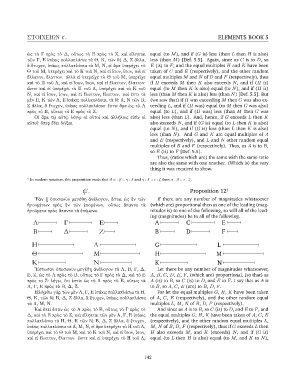
                                                                                Proposition 12
                                                                                                †
               ᾿Εὰν ᾖ ὁποσαοῦν μεγέθη ἀνάλογον, ἔσται ὡς ἓν τῶν    If there are any number of magnitudes whatsoever
            ἡγουμένων πρὸς ἓν τῶν ἑπομένων, οὕτως ἅπαντα τὰ     (which are) proportional then as one of the leading (mag-
            ἡγούμενα πρὸς ἅπαντα τὰ ἑπόμενα.                    nitudes is) to one of the following, so will all of the lead-
                                                                ing (magnitudes) be to all of the following.
               Α            Γ             Ε                       A            C              E

               Β            ∆             Ζ                       B            D              F

              Η                         Λ                         G                         L

              Θ                         Μ                         H                        M
              Κ                         Ν                         K                         N
               ῎Εστωσαν ὁποσαοῦν μεγέθη ἀνάλογον τὰ Α, Β, Γ, Δ,    Let there be any number of magnitudes whatsoever,
            Ε, Ζ, ὡς τὸ Α πρὸς τὸ Β, οὕτως τὸ Γ πρὸς τὸ Δ, καὶ τὸ Ε  A, B, C, D, E, F, (which are) proportional, (so that) as
            πρὸς το Ζ· λέγω, ὅτι ἐστὶν ὡς τὸ Α πρὸς τὸ Β, οὕτως τὰ  A (is) to B, so C (is) to D, and E to F. I say that as A is
            Α, Γ, Ε πρὸς τὰ Β, Δ, Ζ.                            to B, so A, C, E (are) to B, D, F.
               Εἰλήφθω γὰρ τῶν μὲν Α, Γ, Ε ἰσάκις πολλαπλάσια τὰ Η,  For let the equal multiples G, H, K have been taken
            Θ, Κ, τῶν δὲ Β, Δ, Ζ ἄλλα, ἃ ἔτυχεν, ἰσάκις πολλαπλάσια of A, C, E (respectively), and the other random equal
            τὰ Λ, Μ, Ν.                                         multiples L, M, N of B, D, F (respectively).
               Καὶ ἐπεί ἐστιν ὡς τὸ Α πρὸς τὸ Β, οὕτως τὸ Γ πρὸς τὸ  And since as A is to B, so C (is) to D, and E to F, and
            Δ, καὶ τὸ Ε πρὸς τὸ Ζ, καὶ εἴληπται τῶν μὲν Α, Γ, Ε ἰσάκις the equal multiples G, H, K have been taken of A, C, E
            πολλαπλάσια τὰ Η, Θ, Κ τῶν δὲ Β, Δ, Ζ ἄλλα, ἃ ἔτυχεν, (respectively), and the other random equal multiples L,
            ἰσάκις πολλαπλάσια τὰ Λ, Μ, Ν, εἰ ἄρα ὑπερέχει τὸ Η τοῦ Λ, M, N of B, D, F (respectively), thus if G exceeds L then
            ὑπερέχει καὶ τὸ Θ τοῦ Μ, καὶ τὸ Κ τοῦ Ν, καὶ εἰ ἴσον, ἴσον, H also exceeds M, and K (exceeds) N, and if (G is)
            καὶ εἰ ἔλαττον, ἔλαττον. ὥστε καὶ εἰ ὑπερέχει τὸ Η τοῦ Λ, equal (to L then H is also) equal (to M, and K to N),


                                                             142

