


Page 90 - digitalliteracy
P. 90
4.3 Communicating Through Social Media


                   To get a general idea of how these collaborative sites operate and how they and other social
                   networking sites can affect your privacy, let’s look at three examples: Twitter, Facebook, and
                   LinkedIn.


                   Twitter


                   Twitter is an alternative to posting long entries on a blog and allows you to post short state-
                   ments about what you are doing or thinking at any given time of the day. You have a maximum
                   of 280 characters for each post, which is called a tweet. Visit http://www.twitter.com to
                   explore the social media platform.

                   Given how short they are, who would
                   care about these tiny tweets? You may
                   be surprised. In early 2012 Twitter was
                   generating excitement over who would
                   become its 500 millionth user. Twitter
                   can be used to share interesting places
                   you found on the web, ideas you have,
                   a life event (someone  tweeted  at  the
                   altar as he was about to kiss his bride),
                   a frustration, or a question. Registered
                   users  can  read and post tweets, but
                   unregistered users can only read them.
                                                                             Steven Bernard/age fotostock/SuperStock
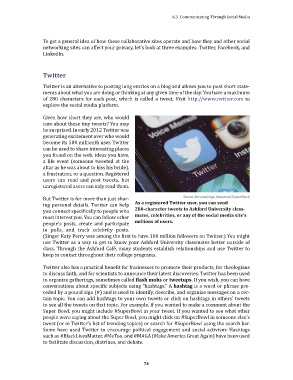
                   But Twitter is for more than just shar-  As a registered Twitter user, you can send
                   ing personal details. Twitter can help   280-character tweets to Ashford University class-
                   you connect specifically to people who   mates, celebrities, or any of the social media site’s
                   most interest you. You can follow other   millions of users.
                   people’s posts, create and participate
                   in polls, and track  celebrity posts.
                   (Singer Katy Perry was among the first to have 100 million followers on Twitter.) You might
                   use Twitter as a way to get to know your Ashford University classmates better outside of
                   class. Through the Ashford Café, many students establish relationships and use Twitter to
                   keep in contact throughout their college programs.

                   Twitter also has a practical benefit for businesses to promote their products, for theologians
                   to discuss faith, and for scientists to announce their latest discoveries. Twitter has been used
                   to organize gatherings, sometimes called flash mobs or tweetups. If you wish, you can have
                   conversations about specific subjects using “hashtags.” A hashtag is a word or phrase pre-
                   ceded by a pound sign (#) and is used to identify, describe, and organize messages on a cer-
                   tain topic. You can add hashtags to your own tweets or click on hashtags in others’ tweets
                   to see all the tweets on that topic. For example, if you wanted to make a comment about the
                   Super Bowl, you might include #SuperBowl in your tweet. If you wanted to see what other
                   people were saying about the Super Bowl, you might click on #SuperBowl in someone else’s
                   tweet (or in Twitter’s list of trending topics) or search for #SuperBowl using the search bar.
                   Some have used Twitter to encourage political engagement and social activism: Hashtags
                   such as #BlackLivesMatter, #MeToo, and #MAGA (Make America Great Again) have been used
                   to facilitate discussion, diatribes, and debate.


                                                             74

