


Page 92 - digitalliteracy
P. 92
4.3 Communicating Through Social Media


                   Facebook


                   If you have not used Facebook, it can be difficult to understand. Using Facebook is not like
                   transforming a paper diary into digital text and putting it on the web, as with a blog. Instead,
                   it is an entirely new communication environment. Websites such as Friendster and Myspace
                   originally defined this genre of web applications. Friendster no longer exists, and Facebook
                   has now trampled Myspace to become the leading social networking site (Chaffey, 2016).

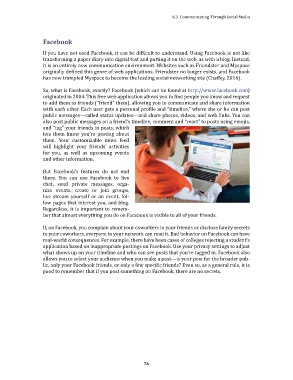
                   So, what is Facebook, exactly? Facebook (which can be found at http://www.facebook.com)
                   originated in 2004. This free web application allows you to find people you know and request
                   to add them as friends (“friend” them), allowing you to communicate and share information
                   with each other. Each user gets a personal profile and “timeline,” where she or he can post
                   public messages—called status updates—and share photos, videos, and web links. You can
                   also post public messages on a friend’s timeline, comment and “react” to posts using emojis,
                   and “tag” your friends in posts, which
                   lets  them know  you’re posting about
                   them. Your customizable news feed
                   will  highlight  your friends’  activities
                   for you,  as well  as upcoming  events
                   and other information.

                   But  Facebook’s  features  do  not  end
                   there. You can use Facebook to live
                   chat, send  private  messages,  orga-
                   nize events, create or join groups,
                   live stream yourself or an  event, fol-
                   low pages that interest you, and blog.
                   Regardless, it is important to remem-
                   ber that almost everything you do on Facebook is visible to all of your friends.

                   If, on Facebook, you complain about your coworkers to your friends or disclose family secrets
                   to your coworkers, everyone in your network can read it. Bad behavior on Facebook can have
                   real-world consequences. For example, there have been cases of colleges rejecting a student’s
                   application based on inappropriate postings on Facebook. Use your privacy settings to adjust
                   what shows up on your timeline and who can see posts that you’re tagged in. Facebook also
                   allows you to select your audience when you make a post—is your post for the broader pub-
                   lic, only your Facebook friends, or only a few specific friends? Even so, as a general rule, it is
                   good to remember that if you post something on Facebook, there are no secrets.


                                                             76

