


Page 53 - ArithBook5thEd ~ BCC
P. 53
9. −π          −4


               10. π         4


                   Before getting down to the nuts and bolts of arithmetic with signed numbers, we address a question
               that may have occurred to you: Why bother with negative numbers? For one thing, they are extremely
               practical. In everyday life, there are many scales of measurement that establish a 0-level, and then go
               “below” it: temperature can go below 0 on a cold day; an elevator can go from the ground floor into
                                                    ◦
               the basement; there are places on land which lie below sea level.We often need to compute sums
               and differences on these scales. For another thing, banking and finance make constant use of signed
               numbers: we make deposits and withdrawals, which are like negative deposits; in business, we record
               profits and losses (negative profits). Finally, there is a theoretical or ‘aesthetic’ reason: the operation of
               subtraction is not yet well-defined. We know what 7 − 5means, but we have avoided 5 − 7, and similar
               subtractions of a larger number from a smaller number. With negative numbers, we will rid ourselves
               of that restriction.
                   We now extend the ordinary operations of addition, subtraction, multiplication and division to all
               signed numbers, so that they remain consistent with the familiar operations with nonnegative numbers.


               2.3     Adding signed numbers


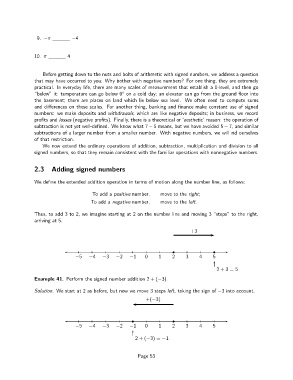
               We define the extended addition operation in terms of motion along the number line, as follows:

                                        To add a positive number,   move to the right;
                                       To add a negative number,    move to the left.

               Thus, to add 3 to 2, we imagine starting at 2 on the number line and moving 3 “steps” to the right,
               arriving at 5.

                                                                                 +3


                                  |    |     |     |    |     |     |          |     |
                                −5    −4    −3   −2    −1     0    1     2     3    4     5

                                                                                            2+ 3 = 5
               Example 41. Perform the signed number addition 2 + (−3).

               Solution. We start at 2 as before, but now we move 3 steps left,taking the sign of −3into account.
                                                              +(−3)


                                  |    |     |     |          |     |          |     |    |
                                −5    −4    −3   −2    −1     0    1     2     3    4     5

                                                          2+ (−3) = −1


                                                           Page 53

