


Page 312 - Kryukov_M_V_-_Sistema_rodstva_kitaytsev_-_1972
P. 312
beginning  of  the  1st  millennium  A.  D.  Chinese  system  was  rich  in  suffixed
        terms  and  was  characterized  by  the  terminological  equalization  of  Fa  Br
        and  Hu  Br,  Fa  Si  and  Hu  Si,  Fa  Si  Hu  and  Mo  Si  Hu,  Bi  So  and  So  So.
        At  the  beginning  of  the  Illnd  millennium  A.  D.  Suffixed  terms  were  gradually
        replaced  by  reduplicated  ones,  the  differentiation  of  BrSo  and  SoSo  was
        followed  by  the merging  of  DaSo and  SfSo.
            In  Part  Three  the  author  deals  with  the  historical  evidences  of  the
        evolution  of  the Chinese  system.
           The  terminology  included  into  the  glossary  of  «Erya»  (III—II  cent.
        B.  C.)  is  analyzed  first.  Then  the  author  goes  back  to  epigraphic  sources
        of  Western  Chou  (Х-ЛХ  cent.  B.  C.)  and  Yin  (XIV—XI  cent.  B.  C.)
        periods.  The  earliest  Chinese  nomenclature  found  in  the  inscriptions  of
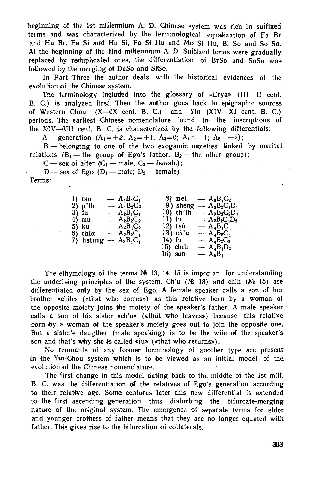
        the  XIV—'VII  cent.  В.  С  is  characterized  by  the  following  differentials:
           A—generation  (Ai =  +2;  A = + I ;  A =0;  A =—1;  A =—2);
                                  2      3     4      5
            В — belonging  to  one  of  the  two  exogamic  moieties  linked  by  marital
        relations  (Bi — the  group  of  Ego's  father;  B2 — the  other  group);
            С —  sex  of  alter  (Ci — male;  C  —female);
                                    2
            D —  sex  of  Ego  (Di —  male;  D  —  female).
                                    2
        Terms:
                   1)  tsu  —  A B,C,    8)  mei  —  A Bfi 2
                               1
                                                      z
                  2)  p'ih  —  A,B C  2  9)  sheng  —  A B C,D|
                                                       2
                                 2
                                                     3
                   3)  fu  —  A B,C,     10)  ch'ih  —  A B C D,
                               2
                                                        2
                                                     3
                                                       2
                  4)  mu   —  A B C 2    11)  fu  —  A B C,D  2
                                                     2
                                 2
                               2
                                                       2
                   5)  ku  —  A B,C 2    12)  tsu  —  А В,С,
                                                     4
                               2
                  6)  chiu  —  A B C,    13)  ch'u  —  A B Ci
                               2
                                 2
                                                     4
                                                       2
                  7)  hsiung  —  A B,C,  14)  fu  —  A B C 2
                                                       2
                                                     4
                               3
                                        15)  chih  —  A B,D  2
                                                     4
                                        16)  sun  —  A B,
                                                     6
            The  ethymology  of  the  terms  №  13,  14,  15  is  important  for  understanding
         the  underlying  principles  of  the  system.  Ch'u  (№  13)  and  chih  (№  15)  are
         differentiated  only  by  the  sex  of  Ego.  A  female  speaker  calls  a  son  of  her
        brother  «chih»  («that  who  comes»)  as  this  relative  born  by  a  woman  of
         the  opposite  moiety  joins  the  moiety  of  the  speaker's  father.  A  male  speaker
         calls  a  son  of  his  sister  «ch'u»  («that  who  leaves»)  because  this  relative
         born  by  a  woman  of  the  speaker's  moiety  goes  out  to  join  the  opposite  one.
         But  a  sister's  daugther  (male  speaking)  is  te  be  the  wife  of  the  speaker's
         son  and that's  why  she  is  called  «!u»  («that  who return's»).
            No  remnants  of  any  former  terminology  of  another  type  are  present
        in  the  Yin-Giou  system  which  is  to  'be  viewed  as  an  initial  model  of  the
         evolution  of  the Chinese nomenclature.
            The  first  change  in  this  model  dating  back  to  the  middle  of  the  1st  mill'.
         В.  С  was  the  differentiation  of  the  relatives  of  Ego's  generation  according
         to  their  relative  age.  Some  centures  later  this  new  differential  is  extended,
         to  the  first  ascending  generation  thus  disturbing  the  bifurcate-merging-
         natuie  of  the  original  system.  The  emergence  of  separate  terms  for  elder
         and  younger  brothers  of  father  means  that  they  are  no  longer  equated  with
         father.  This gives  rise  to  the  bifurcation  of  collaterals.
                                                                   303

