


Page 41 - text book form physics kssm 2020
P. 41
Chapter 2  Force and Motion I

                  Solving Problems of Linear Motion Using Linear Motion Equations
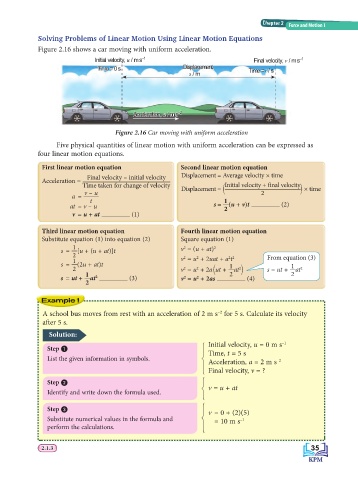
                  Figure 2.16 shows a car moving with uniform acceleration.
                                   Initial velocity, u / m s –1                    Final velocity, v / m s –1
                                                              Displacement,
                                    Time = 0 s                Displacement,       Time = t st / s
                                    Time = 0 s
                                                                                  Time =
                                                                s / m


                                               Acceleration, a / m s –2 –2
                                               Acceleration, a / m s

                                         Figure 2.16 Car moving with uniform acceleration
                        Five physical quantities of linear motion with uniform acceleration can be expressed as
                  four linear motion equations.
                   First linear motion equation              Second linear motion equation
                                 Final velocity – initial velocity   Displacement = Average velocity × time
                   Acceleration =
                                Time taken for change of velocity   Displacement =    Initial velocity + final velocity    × time
                                v – u                                                2
                            a =
                                  t                                       1
                            at = v – u                                 s =  (u + v)t        (2)
                                                                          2
                            v = u + at         (1)
                   Third linear motion equation              Fourth linear motion equation
                   Substitute equation (1) into equation (2)  Square equation (1)
                             1                               v   = (u + at) 2
                                                              2
                         s =  [u + (u + at)]t
                             2                                2   2         2 2        From equation (3)
                             1                               v   = u  + 2uat + a t
                         s =  (2u + at)t                                    1                 1

                             2                               v  = u  + 2a ut +  at     s = ut +  at 2
                                                              2
                                                                  2
                                                                               2
                                 1
                                    2
                                                              2
                                                                  2
                         s = ut +  at         (3)            v   = u  + 2as   2   (4)         2
                                 2
                   Example 1
                                                                        –2
                    A school bus moves from rest with an acceleration of 2 m s  for 5 s. Calculate its velocity
                    after 5 s.
                      Solution:
                                                                     Initial velocity, u = 0 m s
                                                                                            –1
                     Step
                                                                     Time, t = 5 s
                     List the given information in symbols.                               –2
                                                                     Acceleration, a = 2 m s
                                                                     Final velocity, v = ?
                     Step
                                                                     v = u + at
                     Identify and write down the formula used.
                     Step
                                                                     v = 0 + (2)(5)
                     Substitute numerical values in the formula and     = 10 m s –1
                     perform the calculations.
                                                                                                    35
                   2.1.3
                   2.1.3                                                                            35

