


Page 53 - (DK Eyewitness) Travel Guide - Germany
P. 53
INTRODUCING GERM AN Y 51
THE HISTORY OF
GERMANY
Germany is a country of cultural and religious contrasts. Regional differences in
culture, language and traditions arose from the historical division of the country
into many small states. Such differences have been further accentuated by the
recent experience of generations of Germans who, until 1990, grew up under
two conflicting social systems: capitalism and communism.
Early History notably the Goths, often entered into
In the 1st millennium BC, the basins of alliances with the Romans. In the 5th
the Rhine, Danube and Main rivers were century, however, they took advantage
settled by Celts, who had been largely of Rome’s weakness to appropriate
displaced by Germanic tribes by the parts of the empire for themselves.
2nd century BC. In the 1st century BC
the Roman legions waged wars with the Early Middle Ages
Germans, and conquered the territories After the collapse of the Roman Empire,
west of the Rhine. The settlements they the area between the Rhine and the Elbe
founded there later developed into was ruled by the Franks, who gradually
towns like Trier, Mainz, Cologne and converted to Christianity from the 6th
Xanten. The Romans made numerous century. One of the most important
attempts to conquer the eastern regions figures in this process was the 8th-century
between the Rhine and the Elbe rivers. missionary, St Boniface. When Charlemagne
They eventually reached the Elbe at was crowned Emperor in 800, the territory
the end of the 1st century BC, but the of present-day Germany became part
Germans, under the leadership of of the Frankish Empire. The Empire was
Arminius, also known as Germanus, partitioned by the Treaty of Verdun in 843,
defeated the Roman armies in the with the eastern part going to Ludwig the
Teutoburg Forest in AD 9, and so ended German. In the 10th century the kingdom,
their presence in this region. A system which was made up of numerous tribal
of fortifications, or limes, built in the states, passed to the house of Liudolf.
2nd century along the course of the Otto I, son of Heinrich I and the first king
Danube and the Rhine, divided the from this Saxon family, was crowned
region into two: Germania Romana, the Emperor in 962 after several political
Roman province, and Germania Libra, and military victories, in particular his
free Germany. The free German tribes, defeat of the Magyars.
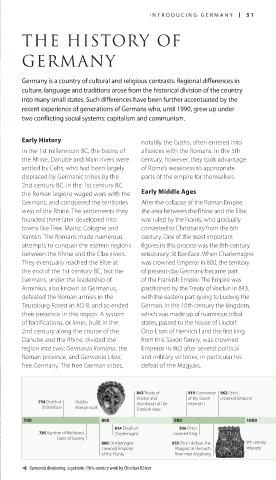
843 Treaty of 919 Coronation 962 Otto I
Verdun and of the Saxon crowned Emperor
754 Death of Golden dissolution of the Heinrich I
St Boniface Roman mask Frankish state
700 800 900 1000
814 Death of 936 Otto I
785 Baptism of Widukind, Charlemagne crowned King
Duke of Saxony
800 Charlemagne 955 Otto I defeats the 8th-century
crowned Emperor Magyars at the Lech reliquary
of the Franks River near Augsburg
Germania Awakening, a patriotic 19th-century work by Christian Köhler
050-053_EW_Germany.indd 51 09/10/17 12:54 pm

