


Page 54 - (DK Eyewitness) Travel Guide - Germany
P. 54
52 INTRODUCING GERM AN Y THE HIST OR Y OF GERM AN Y 53
Consolidating asked the Pope to step northwestern Slavic tribes. From the duchies. In the 13th century a system
Power down. Pope Gregory VII start of the 13th century Barbarossa also evolved by which only seven elector-dukes
With Otto being excommunicated conquered territories occupied by the had the right to elect the emperor. These
crowned emperor, Heinrich. The dukes Baltic peoples and the Estonians, were the Margrave of Brandenburg, the
the dynasty of the of Saxony used the which involved armed expeditions Elector of Palatine (or the Bavarian
Saxon house of opportu nity to by the North German cities and dukes), the Duke of Saxony, the King
Liudolf acceded to appoint a king in orders of knights. of Bohemia and the Archbishops of
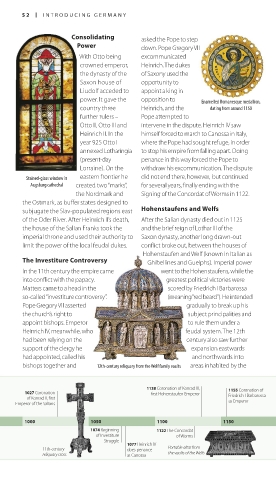
power. It gave the opposition to Enamelled Roman esque medallion, Friedrich II, crowned Emperor Trier, Cologne and Mainz. Starting
country three Heinrich, and the dating from around 1150 in 1220, was also King of Sicily and with Rudolf I of Habsburg, who
further rulers – Pope attempted to his Italian interests brought was elected king of Germany in
Otto II, Otto III and intervene in the dispute. Heinrich IV saw further conflict with the papacy. 1273, until 1438 the kings came
Heinrich II. In the himself forced to march to Canossa in Italy, Ultimately his policies brought from the rival houses of Habsburg,
year 925 Otto I where the Pope had sought refuge, in order about the collapse of imperial Wittelsbach and Luxemburg.
annexed Lotharingia to stop his empire from falling apart. Doing power. After his death in 1250, After 1312, the same houses
(pre sent-day penance in this way forced the Pope to his successor was unable to also competed for the
Lorraine). On the withdraw his excommunication. The dispute find any support, which led title of Emperor. The
Stained-glass window in eastern frontier he did not end there, however, but continued to the period known as the Emperor Rudolf I of Habsburg most outstanding of the
Augsburg cathedral created two “marks”, for several years, finally ending with the Great Interregnum. 14th-century rulers of
the Nordmark and Signing of the Concordat of Worms in 1122. Germany was Karl IV of Luxemburg, who
the Ostmark, as buffer states designed to The Interregnum resided permanently in Prague. In 1338
subjugate the Slav-populated regions east Hohenstaufens and Welfs The fall of the Hohenstaufens marked the the electors had rejected the requirement
of the Oder River. After Heinrich II’s death, After the Salian dynasty died out in 1125 end of the old imperial system. The absence for the Pope to confirm election results. In
the house of the Salian Franks took the and the brief reign of Lothar III of the of an overall ruler led to a breakdown in law 1356 Karl IV issued the “Golden Bull” which
imperial throne and used their authority to Saxon dynasty, another long drawn-out and order, and resulted in the rise of the underlined the federal nature of the state,
limit the power of the local feudal dukes. conflict broke out, between the houses of Raubritter (robber-barons). To protect their and clarified the rules for electing its leader.
Hohenstaufen and Welf (known in Italian as common interests, the trading cities
The Investiture Controversy Ghibellines and Guelphs). Imperial power set up alliances. The collapse of
In the 11th century the empire came went to the Hohenstaufens, while the imperial power, and the decline in the
into conflict with the papacy. greatest political victories were power of the dukes thus gradually led
Matters came to a head in the scored by Friedrich I Barbarossa to an increase in the power of the
so-called “investiture controversy”. (meaning “red beard”). He intended German cities.
Pope Gregory VII asserted gradually to break up his From the beginning, the imperial
the church’s right to subject principalities and throne had been elective, with dukes
appoint bishops. Emperor to rule them under a electing the emperor from the male
Heinrich IV, meanwhile, who feudal system. The 12th members of the dynasty. There was
had been relying on the century also saw further also no capital city, as the emperors
support of the clergy he expansion eastwards moved from one city to another, thus
had appointed, called his and northwards into spreading the costs of maintaining A “Minneteppich” – part of a medieval tapestry, depicting a variety of human
bishops together and 12th-century reliquary from the Welf family vaults areas inhabited by the the imperial court among different traits and a griffin, the mythical beast
1138 Coronation of Konrad III,
1027 Coronation first Hohenstaufen Emperor 1155 Coronation of 1155 Coronation of 1312 Heinrich VII
of Konrad II, first Friedrich I Barbarossa Friedrich I Barbarossa crowned Emperor
Emperor of the Salians as Emperoras Emperor 1250 Beginning of the Silver coin
Great Interregnum from 1369
1000 1050 1100 11501150 1200 1250 1300 1350
1074 Beginning 1122 The Concordat
of Investiture of Worms 1348 Prague University founded
Struggle 1273 End of the Great
1077 Heinrich IV Interregnum and 1386 Heidelberg
11th-century does penance Portable altar from coronation of Rudolf I 1356 Golden Bull issued University founded
reliquary cross at Canossa the vaults of the Welfs
050-053_EW_Germany.indd 52 09/10/17 12:54 pm 050-053_EW_Germany.indd 53 09/10/17 12:54 pm
Eyewitness Travel LAYERS PRINTED:
History Portrait template “UK” LAYER
(Source v1.2)
Date 20th August 2012
Size 125mm x 217mm

