


Page 55 - (DK Eyewitness) Travel Guide - Germany
P. 55
THE HIST OR Y OF GERM AN Y 53
northwestern Slavic tribes. From the duchies. In the 13th century a system
start of the 13th century Barbarossa also evolved by which only seven elector-dukes
conquered territories occupied by the had the right to elect the emperor. These
Baltic peoples and the Estonians, were the Margrave of Brandenburg, the
which involved armed expeditions Elector of Palatine (or the Bavarian
by the North German cities and dukes), the Duke of Saxony, the King
orders of knights. of Bohemia and the Archbishops of
Friedrich II, crowned Emperor Trier, Cologne and Mainz. Starting
in 1220, was also King of Sicily and with Rudolf I of Habsburg, who
his Italian interests brought was elected king of Germany in
further conflict with the papacy. 1273, until 1438 the kings came
Ultimately his policies brought from the rival houses of Habsburg,
about the collapse of imperial Wittelsbach and Luxemburg.
power. After his death in 1250, After 1312, the same houses
his successor was unable to also competed for the
find any support, which led title of Emperor. The
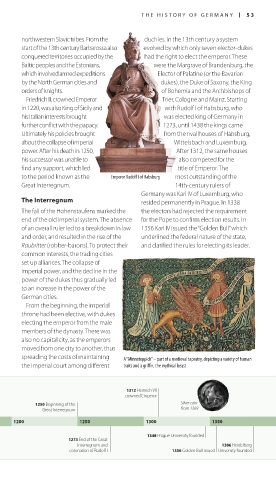
to the period known as the Emperor Rudolf I of Habsburg most outstanding of the
Great Interregnum. 14th-century rulers of
Germany was Karl IV of Luxemburg, who
The Interregnum resided permanently in Prague. In 1338
The fall of the Hohenstaufens marked the the electors had rejected the requirement
end of the old imperial system. The absence for the Pope to confirm election results. In
of an overall ruler led to a breakdown in law 1356 Karl IV issued the “Golden Bull” which
and order, and resulted in the rise of the underlined the federal nature of the state,
Raubritter (robber-barons). To protect their and clarified the rules for electing its leader.
common interests, the trading cities
set up alliances. The collapse of
imperial power, and the decline in the
power of the dukes thus gradually led
to an increase in the power of the
German cities.
From the beginning, the imperial
throne had been elective, with dukes
electing the emperor from the male
members of the dynasty. There was
also no capital city, as the emperors
moved from one city to another, thus
spreading the costs of maintaining A “Minneteppich” – part of a medieval tapestry, depicting a variety of human
the imperial court among different traits and a griffin, the mythical beast
1155 Coronation of 1312 Heinrich VII
Friedrich I Barbarossa crowned Emperor
as Emperor Silver coin
1250 Beginning of the
Great Interregnum from 1369
1150 1200 1250 1300 1350
1348 Prague University founded
1273 End of the Great
Interregnum and 1386 Heidelberg
coronation of Rudolf I 1356 Golden Bull issued University founded
050-053_EW_Germany.indd 53 09/10/17 12:54 pm

