


Page 138 - Ultimate Visual Dictionary (DK)
P. 138
PLANTS
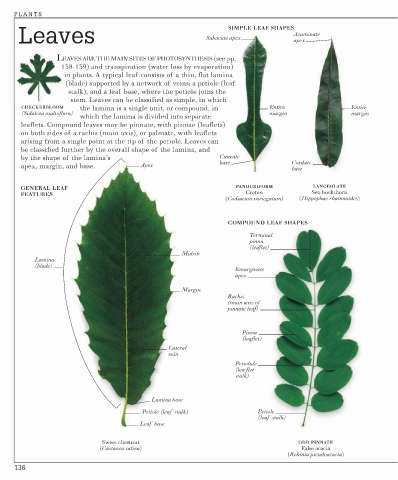
                                                                SIMPLE LEAF SHAPES
      Leaves                                              Subacute apex            Acuminate
                                                                                   apex

                 LEAVES ARE THE MAIN SITES OF PHOTOSYNTHESIS (see pp.
                  138-139) and transpiration (water loss by evaporation)
                   in plants. A typical leaf consists of a thin, flat lamina
                   (blade) supported by a network of veins; a petiole (leaf
                    stalk); and a leaf base, where the petiole joins the
                     stem. Leaves can be classified as simple, in which
       CHECKERBLOOM    the lamina is a single unit, or compound, in         Entire                 Entire
       (Sidalcea malviflora)                                                margin                 margin
                       which the lamina is divided into separate
       leaflets. Compound leaves may be pinnate, with pinnae (leaflets)
       on both sides of a rachis (main axis), or palmate, with leaflets
       arising from a single point at the tip of the petiole. Leaves can
       be classified further by the overall shape of the lamina, and
       by the shape of the lamina’s                           Cuneate
                                                              base                Cordate
       apex, margin, and base.          Apex
                                                                                  base
       GENERAL LEAF                                                PANDURIFORM          LANCEOLATE
       FEATURES                                                      Croton             Sea buckthorn
                                                                (Codiaeum variegatum)  (Hippophae rhamnoides)


                                                                COMPOUND LEAF SHAPES
                                                                      Terminal
                                                                      pinna
                                                                      (leaflet)
                                                    Midrib
           Lamina
           (blade)
                                                                  Emarginate
                                                                  apex
                                                    Margin
                                                                Rachis
                                                                (main axis of
                                                                pinnate leaf)


                                                                    Pinna
                                                                    (leaflet)
                                                Lateral
                                                vein
                                                                  Petiolule
                                                                  (lea flet
                                                                  stalk)


                                           Lamina base
                                        Petiole (leaf  stalk)            Petiole
                                                                         (leaf  stalk)
                                        Leaf  base

                             Sweet chestnut                                         ODD PINNATE
                             (Castanea sativa)                                       False acacia
                                                                                 (Robinia pseudoacacia)

     136

