


Page 140 - Ultimate Visual Dictionary (DK)
P. 140
PLANTS

       Photosynthesis                                                    MICROGRAPH OF LEAF
                                                                         Lily (Lilium sp.)


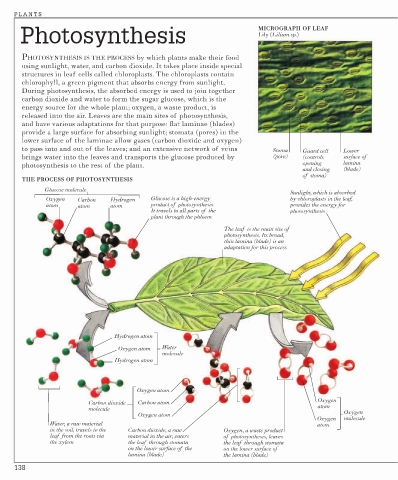
       PHOTOSYNTHESIS IS THE PROCESS by which plants make their food
       using sunlight, water, and carbon dioxide. It takes place inside special
       structures in leaf cells called chloroplasts. The chloroplasts contain
       chlorophyll, a green pigment that absorbs energy from sunlight.
       During photosynthesis, the absorbed energy is used to join together
       carbon dioxide and water to form the sugar glucose, which is the
       energy source for the whole plant; oxygen, a waste product, is
       released into the air. Leaves are the main sites of photosynthesis,
       and have various adaptations for that purpose: flat laminae (blades)
       provide a large surface for absorbing sunlight; stomata (pores) in the
       lower surface of the laminae allow gases (carbon dioxide and oxygen)
       to pass into and out of the leaves; and an extensive network of veins   Stoma   Guard cell   Lower
       brings water into the leaves and transports the glucose produced by   (pore)  (controls   surface of
       photosynthesis to the rest of the plant.                                      opening    lamina
                                                                                     and closing   (blade)
                                                                                     of  stoma)
       THE PROCESS OF PHOTOSYNTHESIS
             Glucose molecule
                                                                                  Sunlight, which is absorbed
              Oxygen   Carbon   Hydrogen   Glucose is a high-energy               by chloroplasts in the leaf,
              atom     atom     atom       product of  photosynthesis.            provides the energy for
                                           It travels to all parts of  the        photosynthesis
                                           plant through the phloem
                                                               The leaf  is the main site of
                                                               photosynthesis. Its broad,
                                                               thin lamina (blade) is an
                                                               adaptation for this process


                                 Hydrogen atom
                                  Oxygen atom  Water
                                              molecule
                                 Hydrogen atom


                                       Oxygen atom
                                                                                         Oxygen
                          Carbon dioxide   Carbon atom
                                                                                         atom
                          molecule                                                               Oxygen
                                       Oxygen atom
                                                                                         Oxygen   molecule
               Water, a raw material                                                     atom
               in the soil, travels to the   Carbon dioxide, a raw   Oxygen, a waste product
               leaf  from the roots via   material in the air, enters   of  photosynthesis, leaves
               the xylem             the leaf  through stomata   the leaf  through stomata
                                     on the lower surface of  the   on the lower surface of
                                     lamina (blade)            the lamina (blade)
     138

