


Page 49 - History of War - Issue 18-15
P. 49
THE BOW THAT BUILT BRITAIN


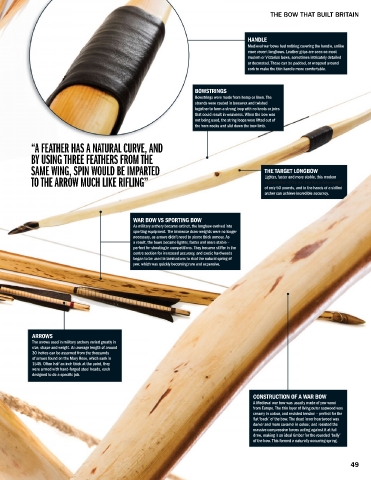
                                                                                        HANDLE
                                                                                        Medieval war bows had nothing covering the handle, unlike
                                                                                        morerecentlongbows.Leathergripsareseenonmost
                                                                                        modern or Victorian bows, sometimes intricately detailed
                                                                                        or decorated. These can be padded, or wrapped around
                                                                                        cork to make the thin handle more comfortable.


                                                                      BOWSTRINGS
                                                                      Bowstrings were made from hemp or linen. The
                                                                      strands were coated in beeswax and twisted
                                                                      together to form a strong loop with no knots or joins
                                                                      that could result in weakness. When the bow was
                                                                      not being used, the string loops were lifted out of
                                                                      the horn nocks and slid down the bow limb.


            “A FEATHER HAS A NATURAL CURVE, AND
            BY USING THREE FEATHERS FROM THE

            SAME WING, SPIN WOULD BE IMPARTED
            TO THE ARROW MUCH LIKE RIFLING”


                                                WAR BOW VS SPORTING BOW
                                                As military archery became extinct, the longbow evolved into
                                                sporting equipment. The immense draw-weights were no longer
                                                necessary, as arrows didn’t need to pierce thick armour. As
                                                a result, the bows became lighter, faster and more stable –
                                                perfect for shooting in competitions. They became stiffer in the
                                                centre section for increased accuracy, and exotic hardwoods
                                                began to be used in laminations to rival the natural spring of
                                                yew, which was quickly becoming rare and expensive.


            ARROWS
            The arrows used in military archery varied greatly in
            size, shape and weight. An average length of around
            30 inches can be assumed from the thousands
            of arrows found on the Mary Rose, which sank in
            1545. Often half an inch thick at the point, they
            were armed with hand-forged steel heads, each
            designed to do a specifi c job.


                                                                                                                            49

