


Page 34 - (DK Eyewitness) Travel Guide - Argentina
P. 34
32 INTRODUCING ARGENTINA
Argentinian Tango
Tango has its roots in the bars and bordellos that sprung
up around Buenos Aires at the turn of the 20th century.
From the cultural melting pot of European immigrants and
Africans, a vibrant music and dance form evolved. While
early tango was played on flute, violin, and guitar, musicians
soon adopted the bandoneón (button accordion) for its
rhythmic energy and melancholic strains. Tango boomed
in Argentina and in Europe in the early 1900s, but declined
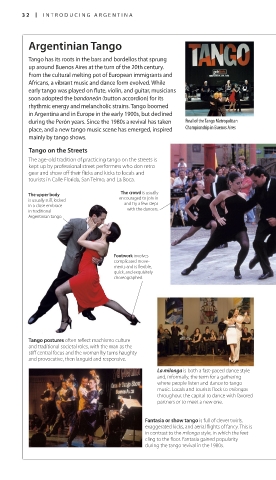
during the Perón years. Since the 1980s a revival has taken Final of the Tango Metropolitan
place, and a new tango music scene has emerged, inspired Championship in Buenos Aires
mainly by tango shows.
Tango on the Streets
The age-old tradition of practicing tango on the streets is
kept up by professional street performers who don retro
gear and show off their flicks and kicks to locals and
tourists in Calle Florida, San Telmo, and La Boca.
The upper body The crowd is usually
is usually stiff, locked encouraged to join in
in a close embrace and try a few steps
in traditional with the dancers.
Argentinian tango.
Footwork involves
complicated move-
ments and is flexible,
quick, and exquisitely
choreographed.
Tango postures often reflect machismo culture
and traditional societal roles, with the man as the
stiff central focus and the woman by turns haughty
and provocative, then languid and responsive.
La milonga is both a fast-paced dance style
and, informally, the term for a gathering
where people listen and dance to tango
music. Locals and tourists flock to milongas
throughout the capital to dance with favored
partners or to meet a new one.
Fantasia or show tango is full of clever twirls,
exaggerated kicks, and aerial flights of fancy. This is
in contrast to the milonga style, in which the feet
cling to the floor. Fantasia gained popularity
during the tango revival in the 1980s.
032-033_EW_Argentina.indd 32 05/08/16 10:03 am

