


Page 38 - DK Eyewitness Travel Guides - The World's Must-See Places
P. 38
36  EUROPE                                     Hampton Court Palace, London


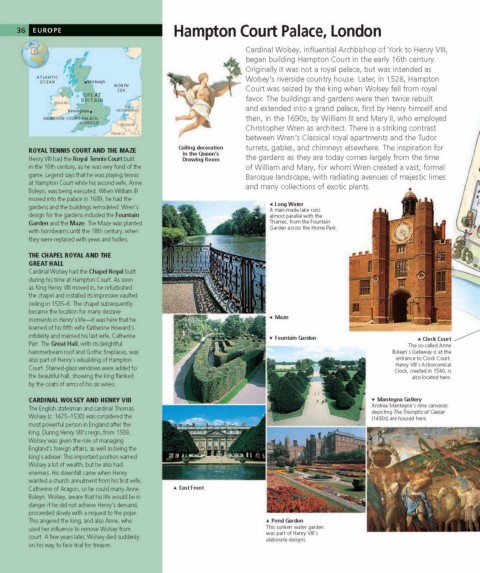
                                                                          Cardinal Wolsey, influential Archbishop of York to Henry VIII,
                                                                          began building  Hampton Court in the early 16th century.
                                                                          Originally it was not a royal  palace,  but was intended as
            A TLAI'JTIC                                                   Wolsey's riverside country house.  Later,  in  1528, Hampton
             OCEAI'J
                                   f'JORTii
                                    SEA                                   Court was seized  by the king when Wolsey fell  from royal
                          (,i RE AT
                         BR ITAI N                                        favor.  The  buildings and gardens were then  twice rebuilt
                 ~E.LAND
                                                                          and extended into a grand  palace,  first by Henry himself and
                     Birmingham •
                            .
              HAMPWN COURT  PALACE,                                       then,  in  the 1690s, by William Ill and Mary II, who employed
                         LONDON
                                                                          Christopher Wren as  architect.  There is a striking contrast
                                                                          between Wren's Classical  royal apartments and the Tudor
                                                      Ceiling decoration   turrets, gables, and chimneys elsewhere.  The inspiration for
         ROYAL TENNIS COURT AND lHE MAZE
                                                       in the Queen's
         Henry VIII had the Royal Tennis Court built   Drawing Room       the gardens as  they are today comes largely from the time
         in the 16th century, as he was very fond of the                  of William and Mary, for whom Wren created a vast,  formal
         game. Legend says that he was playing tennis                     Baroque landscape, with radiating avenues of majestic limes
         at Hampton Court while his second wife, Anne
                                                                          and many collections of exotic plants.
         Boleyn, was being executed. When William Ill
         moved into the palace in 1689, he had the
         gardens and the buildings rem ode I ed. Wren's                          <Long Water
                                                                                 A man-made I ake runs
         design for the gardens included the Fountain                            almost parallel with the
         Garden and the Maze. The Maze was planted                               Thames, from the Fountain
                                                                                 Garden across the Home Park.
         with hornbeams until the 18th century, when
         they were replaced with yews and hollies.

         THE CHAPEL ROYAL AND lHE
         GREAT HALL
         Cardinal Wolsey had the Chapel Royal built
         during his time at Hampton Court. As soon
         as King Henry VIII moved in, he refurbished
         the chapel and installed its impressive vaulted
         ceiling in 1535-6. The chapel subsequently
         became the location for many decisive
         moments in Henry's life-it was here that he
         learned of his fifth wife Katherine Howard's
         infidelity and married his last wife, Catherine                         Y  Fountain Garden                          A Clock Court ~
         Parr. The Great Hall, with its delightful                                                                         The so-called Anne
         hammerbeam roof and Gothic fireplaces, was                                                                   Boleyn's Gateway is at the
         also part of Henry's rebuilding of Hampton                                                                    entrance to Clock Court
                                                                                                                       Henry VIII's Astronomical
         Court. Stained-glass windows were added to
                                                                                                                       Clock, created in  1540, is
         the beautiful hall, showing the king flanked                                                                       also located here.
         by the coats of arms of his six wives.
         CARDINAL WOLSEY AND HENRY VIII                                                                         v  Mantegna Gallery
                                                                                                                Andrea Mantegna's nine canvases
          The English statesman and cardinal  Thorn as
                                                                                                                depicting The Triumphs of Caesar
         Wolsey (c 1475-1530) was considered the                                                                (1480s) are housed here.
         most powerful person in England after the
         king. During Henry VIII's reign, from  1509,
         Wolsey was given the role of managing
         England's foreign aft airs, as well as being the
         king' s adviser. This important position earned
         Wolsey a lot of wealth, but he also had
         enemies. His downfall came when Henry
         wanted a church annulment from his first wife,
         Catherine of Aragon, so he could marry Anne   A East Front
         Boleyn. Wolsey, aware that his life would be in
         dangerif he did not achieve Henry's demand,
         proceeded slowly with a request to the pope.
         This angered the king, and also Anne, who                              A  Pond Garden
         used her influence to remove Wolsey from                               This sunken water garden
                                                                                was part of Henry VIII's
         court. A few years later, Wolsey died suddenly
                                                                                elaborate designs.
         on his way to face trial for treason.

