


Page 34 - (DK Eyewitness) Travel Guide - Australia
P. 34
32 INTRODUCING A USTR ALIA
The Australian Outback
The Outback is the heart of Australia and one of the most
ancient landscapes in the world. It is extremely dry – rain
may not fall for several years. Dramatic red rocks, ochre
plains and purple mountains are framed by brilliant blue
skies. Development is sparse: “towns” are often no more
than a few buildings and facilities are basic. There may
be hundreds of miles between one petrol station and Locator Map
another. The Outback isn’t easy to explore, but it can be a The Australian Outback
rewarding experience. Make sure you are well equipped
(see p562), or take an organized tour.
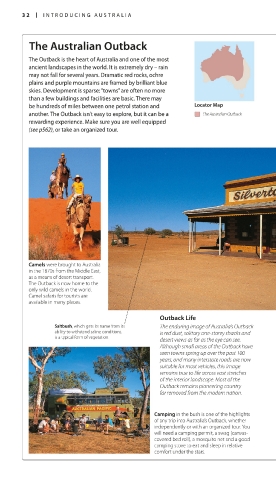
Camels were brought to Australia
in the 1870s from the Middle East,
as a means of desert transport.
The Outback is now home to the
only wild camels in the world.
Camel safaris for tourists are
available in many places.
Outback Life
Saltbush, which gets its name from its The enduring image of Australia’s Outback
ability to withstand saline conditions, is red dust, solitary one-storey shacks and
is a typical form of vegetation.
desert views as far as the eye can see.
Although small areas of the Outback have
seen towns spring up over the past 100
years, and many interstate roads are now
suitable for most vehicles, this image
remains true to life across vast stretches
of the interior landscape. Most of the
Outback remains pioneering country
far removed from the modern nation.
Camping in the bush is one of the highlights
of any trip into Australia’s Outback, whether
independently or with an organized tour. You
will need a camping permit, a swag (canvas-
covered bed roll), a mosquito net and a good
camping stove to eat and sleep in relative
comfort under the stars.

