


Page 170 - Encyclopedia of Aquarium and Pond Fish, 3rd Edition
P. 170
168    FRESHWATER FISH DIRECTORY


          Poecilia butleri
         Pacific Mexican Molly           The coloration of Pacific Mexican Mollies in   derives from melanistic examples of the wild form.
                                         the wild is variable, ranging from shades of    Like the Pacific Mexican, the Black Molly has
           ORIGINS  Central America, ranging from northern Mexico   blue to yellowish and silvery tones. Darker   a low dorsal fin, a relatively elongated body, and a
           into Guatemala and Honduras.  coloration is seen in some individuals, notably    compact, rounded caudal fin. The black coloration
              1
           SIZE  3 ⁄2 in (8.5 cm).       in the race known as Limantour’s Molly (P. m.   has also been combined with marbled and balloon
           DIET  Prepared foods, vegetables, and small live foods.  limantouri). The wild Pacific Mexican Molly is the   characteristics. Black varieties look good in an
           WATER  Temperature 75–81°F (24–27°C); hard   ancestor of the Black Molly, the most popular of   aquarium alongside bright orange swordtails (see
           (100–150 mg/l) and alkaline (pH 7.5).  the domesticated varieties available today. The   p.160). These fish often fare better when kept in
           TEMPERAMENT  Placid and social.  Black Molly was created in the 1930s by a breeder   slightly brackish water. This seems to make them
                                         in New Orleans, although the exact route of    less vulnerable to the parasitic illness known as
                                                   its development is now unclear.    “ich,” or white spot (see p.58), which shows up
                                                     Its distinctive matt-black   clearly against the color of their bodies. Females
                                                      coloration almost certainly   typically produce 40–300 offspring per brood.
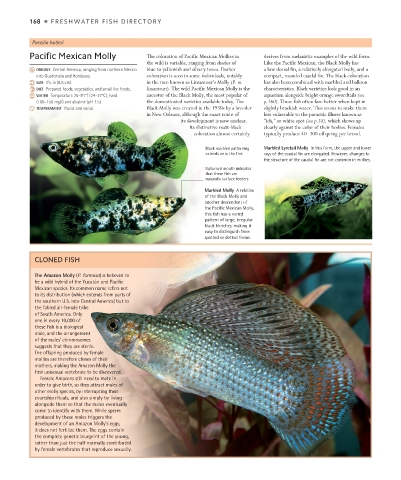
                                                          Black marbled patterning   Marbled Lyretail Molly  In this form, the upper and lower
                                                          extends onto the fins  rays of the caudal fin are elongated. However, changes to
                                                                          the structure of the caudal fin are not common in mollies.
                                                          Upturned mouth indicates
                                                          that these fish are
                                                          naturally surface feeders
                                                         Marbled Molly  A relative
                                                         of the Black Molly and
                                                         another descendant of
                                                         the Pacific Mexican Molly,
                                                         this fish has a varied
                                                         pattern of large, irregular
                                                         black blotches, making it
                                                         easy to distinguish from
                                                         spotted or dotted forms.


           CLONED FISH

           The Amazon Molly (P. formosa) is believed to
           be a wild hybrid of the Yucatán and Pacific
           Mexican species. Its common name refers not
           to its distribution (which extends from parts of
           the southern U.S. into Central America) but to
           the fabled all-female tribe
           of South America. Only
           one in every 10,000 of
           these fish is a biological
           male, and the arrangement
           of the males’ chromosomes
           suggests that they are sterile.
           The offspring produced by female
           mollies are therefore clones of their
           mothers, making the Amazon Molly the
           first unisexual vertebrate to be discovered.
             Female Amazons still need to mate in
           order to give birth, so they attract males of
           other molly species, by interrupting their
           courtship rituals, and also simply by living
           alongside them so that the males eventually
           come to identify with them. While sperm
           produced by these males triggers the
           development of an Amazon Molly’s eggs,
           it does not fertilize them. The eggs contain
           the complete genetic blueprint of the young,
           rather than just the half normally contributed
           by female vertebrates that reproduce sexually.


   US_168-169_Mollies.indd   168                                                                    14/09/18   12:07 PM

