


Page 165 - Encyclopedia of Aquarium and Pond Fish, 3rd Edition
P. 165
LIVEBEARERS/PLATIES     163


                                                    Yellow may shine
                                                    through the black
                                                    in places
                               Male’s
                               gonopodium
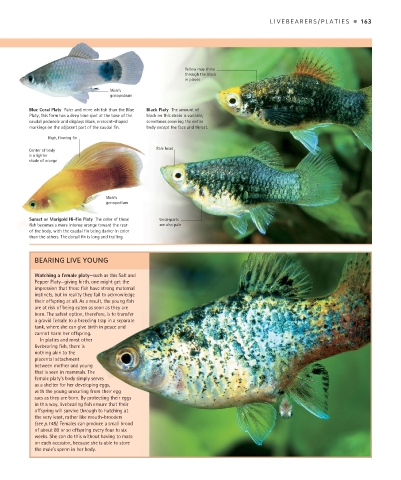
         Blue Coral Platy  Paler and more whitish than the Blue   Black Platy  The amount of
         Platy, this form has a deep blue spot at the base of the   black on this strain is variable,
         caudal peduncle and displays black, crescent-shaped   sometimes covering the entire
         markings on the adjacent part of the caudal fin.  body except the face and throat.
              High, flowing fin
         Center of body                     Pale head
         is a lighter
         shade of orange


                              Male’s
                              gonopodium
         Sunset or Marigold Hi-Fin Platy  The color of these   Underparts
         fish becomes a more intense orange toward the rear    are also pale
         of the body, with the caudal fin being darker in color
         than the others. The dorsal fin is long and trailing.


           BEARING LIVE YOUNG

           Watching a female platy—such as this Salt and
           Pepper Platy—giving birth, one might get the
           impression that these fish have strong maternal
           instincts, but in reality they fail to acknowledge
           their offspring at all. As a result, the young fish
           are at risk of being eaten as soon as they are
           born. The safest option, therefore, is to transfer
           a gravid female to a breeding trap in a separate
           tank, where she can give birth in peace and
           cannot harm her offspring.
             In platies and most other
           livebearing fish, there is
           nothing akin to the
           placental attachment
           between mother and young
           that is seen in mammals. The
           female platy’s body simply serves
           as a shelter for her developing eggs,
           with the young uncurling from their egg
           sacs as they are born. By protecting their eggs
           in this way, livebearing fish ensure that their
           offspring will survive through to hatching at
           the very least, rather like mouth-brooders
           (see p.148). Females can produce a small brood
           of about 80 or so offspring every four to six
           weeks. She can do this without having to mate
           on each occasion, because she is able to store
           the male’s sperm in her body.


   US_162-163_Platies.indd   163                                                                     29/08/18   4:09 PM

