


Page 175 - Encyclopedia of Aquarium and Pond Fish, 3rd Edition
P. 175
KILLIFISH     173


          Epiplatys sexfasciatus          Aplocheilus blockii             Aplocheilus dayi
         Six-Barred Panchax              Dwarf Panchax                    Day’s Green Panchax

           ORIGINS  West Africa, where its distribution is restricted   ORIGINS  Asia, occurring in southern India in the vicinity   ORIGINS  Asia, occurring in southern India in the vicinity
           to Cameroon.                    of Madras; may also occur on Sri Lanka.  of Madras; may also occur in Sri Lanka.
           SIZE  4 ⁄4 in (11 cm).          SIZE  2 in (5 cm).               SIZE  2 in (5 cm).
              1
           DIET  Small live foods and prepared diets.  DIET  Live foods and prepared diets.  DIET  Small live foods and prepared diets.
           WATER  Temperature 73 –82°F (23–28°C); soft    WATER  Temperature 73–79°F (23–26°C); soft    WATER  Temperature 73–82°F (23–28°C); soft
           (50–100 mg/l) and acidic (pH 6.0).   (50–100 mg/l) and acidic (pH 6.0).   (50–100 mg/l) and acidic (pH 6.0).
           TEMPERAMENT  Relatively peaceful.  TEMPERAMENT  Peaceful.        TEMPERAMENT  Peaceful.
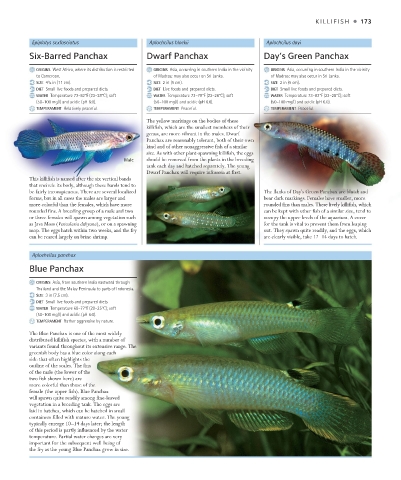
                                         The yellow markings on the bodies of these
                                         killifish, which are the smallest members of their
                                         genus, are more vibrant in the males. Dwarf
                                         Panchax are reasonably tolerant, both of their own
                                         kind and of other nonaggressive fish of a similar
                                         size. As with other plant-spawning killifish, the eggs
                                   Male  should be removed from the plants in the breeding
                                         tank each day and hatched separately. The young
                                         Dwarf Panchax will require infusoria at first.
         This killifish is named after the six vertical bands
         that encircle its body, although these bands tend to
         be fairly inconspicuous. There are several localized             The flanks of Day’s Green Panchax are bluish and
         forms, but in all cases the males are larger and                 bear dark markings. Females have smaller, more
         more colorful than the females, which have more                  rounded fins than males. These lively killifish, which
         rounded fins. A breeding group of a male and two                 can be kept with other fish of a similar size, tend to
         or three females will spawn among vegetation such                occupy the upper levels of the aquarium. A cover
         as Java Moss (Vesicularia dubyana), or on a spawning             for the tank is vital to prevent them from leaping
         mop. The eggs hatch within two weeks, and the fry                out. They spawn quite readily, and the eggs, which
         can be reared largely on brine shrimp.                           are clearly visible, take 12–14 days to hatch.

          Aplocheilus panchax
         Blue Panchax

           ORIGINS  Asia, from southern India eastward through
           Thailand and the Malay Peninsula to parts of Indonesia.
           SIZE  3 in (7.5 cm).
           DIET  Small live foods and prepared diets.
           WATER  Temperature 68–77°F (20–25°C); soft
           (50–100 mg/l) and acidic (pH 6.0).
           TEMPERAMENT  Rather aggressive by nature.
         The Blue Panchax is one of the most widely
         distributed killifish species, with a number of
         variants found throughout its extensive range. The
         greenish body has a blue color along each
         side that often highlights the
         outline of the scales. The fins
         of the male (the lower of the
         two fish shown here) are
         more colorful than those of the
         female (the upper fish). Blue Panchax
         will spawn quite readily among fine-leaved
         vegetation in a breeding tank. The eggs are
         laid in batches, which can be hatched in small
         containers filled with mature water. The young
         typically emerge 10–14 days later; the length
         of this period is partly influenced by the water
         temperature. Partial water changes are very
         important for the subsequent well-being of
         the fry as the young Blue Panchax grow in size.


   US_172-173_Killifish.indd   173                                                                   29/08/18   4:09 PM

