


Page 173 - Encyclopedia of Aquarium and Pond Fish, 3rd Edition
P. 173
KILLIFISH     171


          Aphyosemion bitaeniatum         Fundulopanchax gardneri         Fundulopanchax sjostedti
         Twin-Banded Killifish           Clausen’s Steel-Blue Killie      Blue Gularis

           ORIGINS  West Africa, occurring in coastal parts of   ORIGINS  West Africa, recorded in parts of Nigeria and   ORIGINS  West Africa, found in shallow waters in Ghana,
           Nigeria, Benin, and Togo.       western Cameroon.                Cameroon, and Nigeria.
           SIZE  2 in (5 cm).              SIZE  3 in (7.5 cm).             SIZE  5 in (13 cm).
           DIET  Live foods and prepared diets.  DIET  Live foods and prepared diets.  DIET  Live foods and prepared diets.
           WATER  Temperature 72–75°F (22–24°C); soft   WATER  Temperature 72–79°F (22–26°C); soft    WATER  Temperature 73–79°F (23–26°C); soft
           (50–100 mg/l) and acidic (pH 6.0–6.5).  (50–100 mg/l) and acidic (pH 6.0–6.5).   (50–100 mg/l) and acidic (pH 6.0–6.5).
           TEMPERAMENT  Males can be quarrelsome.  TEMPERAMENT  Males are quarrelsome.  TEMPERAMENT  Relatively aggressive.
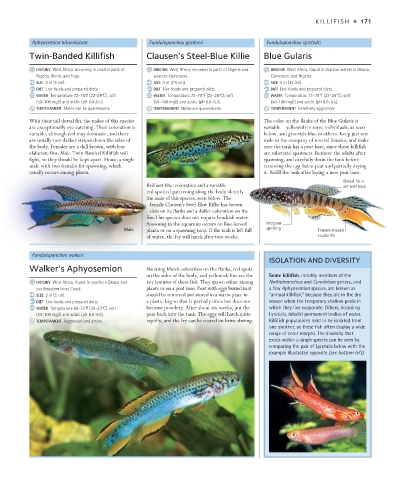
         With their tall dorsal fin, the males of this species            The color on the flanks of the Blue Gularis is
         are exceptionally eye-catching. Their coloration is              variable—yellowish in some individuals, as seen
         variable, although red may dominate, and there                   below, and greenish-blue in others. Keep just one
         are usually two darker stripes down the sides of                 male in the company of several females, and make
         the body. Females are a dull brown, with less                    sure the tank has a peat base, since these killifish
         elaborate fins. Male Twin-Banded Killifish will                  are substrate-spawners. Remove the adults after
         fight, so they should be kept apart. House a single              spawning, and carefully drain the tank before
         male with two females for spawning, which                        removing the egg-laden peat and partially drying
         usually occurs among plants.                                     it. Refill the tank after laying a new peat base.
                                                                                                Dorsal fin is
                                         Brilliant blue coloration and a variable               set well back
                                         red-spotted patterning along the body identify
                                         the male of this species, seen below. The
                                          female Clausen’s Steel-Blue Killie has brown
                                          dots on its flanks and a duller coloration on the
                                         fins.This species does not require brackish water.
                                         Spawning in the aquarium occurs on fine-leaved   Irregular
                                   Male  plants or on a spawning mop. If the tank is left full   spotting  Trident-shaped
                                         of water, the fry will hatch after two weeks.   caudal fin

          Fundulopanchax walkeri
                                                                           ISOLATION AND DIVERSITY
         Walker’s Aphyosemion            Stunning bluish coloration on the flanks, red spots
                                         on the sides of the body, and yellowish fins are the   Some killifish, notably members of the
           ORIGINS  West Africa, found in southern Ghana and   key features of these fish. They spawn either among   Nothobranchius and Cynolebias genera, and
           southeastern Ivory Coast.     plants or on a peat base. Peat with eggs buried in it   a few Aphyosemion species, are known as
           SIZE  2 in (5 cm).            should be removed and stored in a warm place in    “annual killifish,” because they die in the dry
           DIET  Live foods and prepared diets.  a plastic bag so that it partially dries but does not   season when the temporary shallow pools in
           WATER  Temperature 68–73°F (20–23°C); soft    become powdery. After about six weeks, put the   which they live evaporate. Others, including
           (50–100 mg/l) and acidic (pH 6.0–6.5).  peat back into the tank. The eggs will hatch quite   Lyretails, inhabit permanent bodies of water.
           TEMPERAMENT  Aggressive and active.  rapidly, and the fry can be reared on brine shrimp.  Killifish populations tend to be isolated from
                                                                           one another, so these fish often display a wide
                                                                           range of color morphs. The diversity that
                                                                           exists within a single species can be seen by
                                                                           comparing the pair of Lyretails below with the
                                                                           example illustrated opposite (see bottom left).


   US_170-171_Killifish.indd   171                                                                   29/08/18   4:09 PM

