


Page 174 - Encyclopedia of Aquarium and Pond Fish, 3rd Edition
P. 174
172    FRESHWATER FISH DIRECTORY


          Nothobranchius palmqvisti
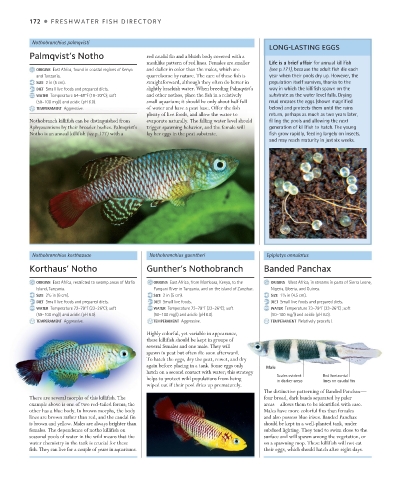
                                                                           LONG-LASTING EGGS
         Palmqvist’s Notho               red caudal fin and a bluish body covered with a
                                         meshlike pattern of red lines. Females are smaller   Life is a brief affair for annual killifish
           ORIGINS  East Africa, found in coastal regions of Kenya   and duller in color than the males, which are   (see p.171), because the adult fish die each
           and Tanzania.                 quarrelsome by nature. The care of these fish is   year when their pools dry up. However, the
           SIZE  2 in (5 cm).            straightforward, although they often do better in   population itself survives, thanks to the
           DIET  Small live foods and prepared diets.  slightly brackish water. When breeding Palmqvist’s   way in which the killifish spawn on the
           WATER  Temperature 64–68°F (18–20°C); soft    and other nothos, place the fish in a relatively    substrate as the water level falls. Drying
           (50–100 mg/l) and acidic (pH 6.0).   small aquarium; it should be only about half full    mud encases the eggs (shown magnified
           TEMPERAMENT  Aggressive.      of water and have a peat base. Offer the fish   below) and protects them until the rains
                                         plenty of live foods, and allow the water to   return, perhaps as much as two years later,
         Nothobranch killifish can be distinguished from   evaporate naturally. The falling water level should   filling the pools and allowing the next
         Aphyosemions by their broader bodies. Palmqvist’s   trigger spawning behavior, and the female will    generation of killifish to hatch. The young
         Notho is an annual killifish (see p.171) with a    lay her eggs in the peat substrate.  fish grow rapidly, feeding largely on insects,
                                                                           and may reach maturity in just six weeks.


          Nothobranchius korthausae       Nothobranchius guentheri        Epiplatys annulatus
         Korthaus’ Notho                 Gunther’s Nothobranch            Banded Panchax

           ORIGINS  East Africa, restricted to swamp areas of Mafia   ORIGINS  East Africa, from Mombasa, Kenya, to the   ORIGINS   West Africa, in streams in parts of Sierra Leone,
           Island, Tanzania.               Pangani River in Tanzania, and on the island of Zanzibar.   Nigeria, Liberia, and Guinea.
           SIZE  2 ⁄2 in (6 cm).           SIZE  2 in (5 cm).               SIZE  1 ⁄4 in (4.5 cm).
              1
                                                                               3
           DIET  Small live foods and prepared diets.  DIET  Small live foods.  DIET  Small live foods and prepared diets.
           WATER  Temperature 73–79°F (23–26°C); soft    WATER  Temperature 73–79°F (23–26°C); soft    WATER  Temperature 73–79°F (23–26°C); soft
           (50–100 mg/l) and acidic (pH 6.0).   (50–100 mg/l) and acidic (pH 6.0).   (50–100 mg/l) and acidic (pH 6.0).
           TEMPERAMENT  Aggressive.        TEMPERAMENT  Aggressive.         TEMPERAMENT  Relatively peaceful.
                                         Highly colorful, yet variable in appearance,
                                         these killifish should be kept in groups of
                                         several females and one male. They will
                                         spawn in peat but often die soon afterward.
                                         To hatch the eggs, dry the peat, rewet, and dry
                                         again before placing in a tank. Some eggs only    Male
                                         hatch on a second contact with water; this strategy
                                         helps to protect wild populations from being   Scales evident   Red horizontal
                                                                                          lines on caudal fin
                                                                             in darker areas
                                         wiped out if their pool dries up prematurely.
                                                                          The distinctive patterning of Banded Panchax—
         There are several morphs of this killifish. The                  four broad, dark bands separated by paler
         example above is one of two red-tailed forms; the                areas—allows them to be identified with ease.
         other has a blue body. In brown morphs, the body                 Males have more colorful fins than females
         lines are brown rather than red, and the caudal fin              and also possess blue irises. Banded Panchax
         is brown and yellow. Males are always brighter than              should be kept in a well-planted tank, under
         females. The dependence of notho killifish on                    subdued lighting. They tend to swim close to the
         seasonal pools of water in the wild means that the               surface and will spawn among the vegetation, or
         water chemistry in the tank is crucial for these                 on a spawning mop. These killifish will not eat
         fish. They can live for a couple of years in aquariums.          their eggs, which should hatch after eight days.


   US_172-173_Killifish.indd   172                                                                   29/08/18   4:09 PM

