


Page 204 - Encyclopedia of Aquarium and Pond Fish, 3rd Edition
P. 204
202    INTRODUCTION TO MARINE FISH

         What to consider


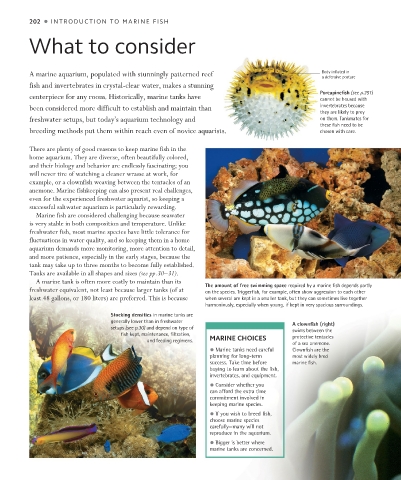
         A marine aquarium, populated with stunningly patterned reef                      Body inflated in
                                                                                          a defensive posture
         fish and invertebrates in crystal-clear water, makes a stunning
         centerpiece for any room. Historically, marine tanks have                       Porcupinefish (see p.251)
                                                                                         cannot be housed with
         been considered more difficult to establish and maintain than                   invertebrates because
                                                                                         they are likely to prey
         freshwater setups, but today’s aquarium technology and                          on them. Tankmates for
                                                                                         these fish need to be
         breeding methods put them within reach even of novice aquarists.                chosen with care.

         There are plenty of good reasons to keep marine fish in the
         home aquarium. They are diverse, often beautifully colored,
         and their biology and behavior are endlessly fascinating; you
         will never tire of watching a cleaner wrasse at work, for
         example, or a clownfish weaving between the tentacles of an
         anemone. Marine fishkeeping can also present real challenges,
         even for the experienced freshwater aquarist, so keeping a
         successful saltwater aquarium is particularly rewarding.
           Marine fish are considered challenging because seawater
         is very stable in both composition and temperature. Unlike
         freshwater fish, most marine species have little tolerance for
         fluctuations in water quality, and so keeping them in a home
         aquarium demands more monitoring, more attention to detail,
         and more patience, especially in the early stages, because the
         tank may take up to three months to become fully established.
         Tanks are available in all shapes and sizes (see pp.30–31).
           A marine tank is often more costly to maintain than its
         freshwater equivalent, not least because larger tanks (of at   The amount of free swimming space required by a marine fish depends partly
                                                          on the species. Triggerfish, for example, often show aggression to each other
         least 48 gallons, or 180 liters) are preferred. This is because    when several are kept in a smaller tank, but they can sometimes live together
                                                          harmoniously, especially when young, if kept in very spacious surroundings.
                                Stocking densities in marine tanks are
                                generally lower than in freshwater                A clownfish (right)
                                setups (see p.30) and depend on type of           swims between the
                                  fish kept, maintenance, filtration,             protective tentacles
                                          and feeding regimens.  MARINE CHOICES   of a sea anemone.
                                                           •  Marine tanks need careful   Clownfish are the
                                                           planning for long-term   most widely bred
                                                           success. Take time before   marine fish.
                                                           buying to learn about the fish,
                                                           invertebrates, and equipment.
                                                           •  Consider whether you
                                                           can afford the extra time
                                                           commitment involved in
                                                           keeping marine species.
                                                           •  If you wish to breed fish,
                                                           choose marine species
                                                           carefully—many will not
                                                           reproduce in the aquarium.
                                                           •  Bigger is better where
                                                           marine tanks are concerned.


   US_202-205_What_to_consider.indd   202                                                            29/08/18   4:10 PM

