


Page 200 - Encyclopedia of Aquarium and Pond Fish, 3rd Edition
P. 200
198    FRESHWATER PLANT DIRECTORY


          Anubias barteri
         Barter’s Anubias

           ORIGINS  West Africa, occurring in Nigeria, Gabon, Ivory
           Coast, and Cameroon.
           SIZE  Leaves may be up to 12 in (30 cm) long.
           WATER  Temperature 72–77°F (22–25°C); hard
           (100–150 mg/l) and around neutral (pH 6.0–7.5).
           PROPAGATION  Divide the rhizome and transplant the
           pieces to different areas of the tank.
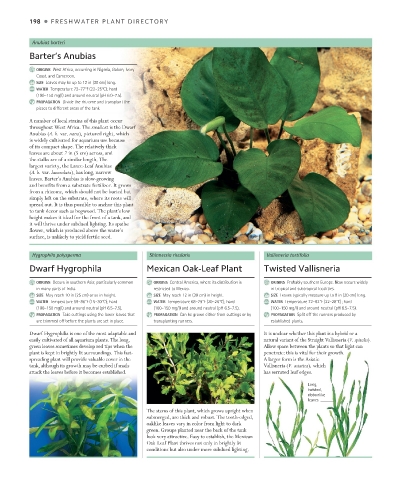
         A number of local strains of this plant occur
         throughout West Africa. The smallest is the Dwarf
         Anubias (A. b. var. nana), pictured right, which
         is widely cultivated for aquarium use because
         of its compact shape. The relatively thick
         leaves are about 2 in (5 cm) across, and
         the stalks are of a similar length. The
         largest variety, the Lance-Leaf Anubias
         (A. b. var. lanceolata), has long, narrow
         leaves. Barter’s Anubias is slow-growing
         and benefits from a substrate fertilizer. It grows
         from a rhizome, which should not be buried but
         simply left on the substrate, where its roots will
         spread out. It is thus possible to anchor this plant
         to tank decor such as bogwood. The plant’s low
         height makes it ideal for the front of a tank, and
         it will thrive under subdued lighting. Its spathe
         flower, which is produced above the water’s
         surface, is unlikely to yield fertile seed.

          Hygrophila polysperma           Shinnersia rivularis            Vallisneria tortifolia
         Dwarf Hygrophila                Mexican Oak-Leaf Plant           Twisted Vallisneria

           ORIGINS  Occurs in southern Asia; particularly common   ORIGINS  Central America, where its distribution is   ORIGINS  Probably southern Europe. Now occurs widely
           in many parts of India.         restricted to Mexico.            in tropical and subtropical localities.
           SIZE  May reach 10 in (25 cm) or so in height.  SIZE  May reach 12 in (30 cm) in height.  SIZE  Leaves typically measure up to 8 in (20 cm) long.
           WATER  Temperature 59–86°F (15–30°C); hard   WATER  Temperature 68–79°F (20–26°C); hard   WATER  Temperature 72–82°F (22–28°C); hard
           (100–150 mg/l) and around neutral (pH 6.5–7.5).  (100–150 mg/l) and around neutral (pH 6.5–7.5).  (100–150 mg/l) and around neutral (pH 6.5–7.5).
           PROPAGATION  Take cuttings using the lower leaves that   PROPAGATION  Can be grown either from cuttings or by   PROPAGATION  Split off the runners produced by
           are trimmed off before the plants are set in place.  transplanting runners.  established plants.
         Dwarf Hygrophilia is one of the most adaptable and               It is unclear whether this plant is a hybrid or a
         easily cultivated of all aquarium plants. The long,              natural variant of the Straight Vallisneria (V. spiralis).
         green leaves sometimes develop red tips when the                 Allow space between the plants so that light can
         plant is kept in brightly lit surroundings. This fast-           penetrate: this is vital for their growth.
         spreading plant will provide valuable cover in the               A larger form is the Asiatic
         tank, although its growth may be curbed if snails                Vallisneria (V. asiatica), which
         attack the leaves before it becomes established.                 has serrated leaf edges.

                                                                                      Long,
                                                                                      twisted,
                                                                                      ribbonlike
                                                                                      leaves
                                         The stems of this plant, which grows upright when
                                         submerged, are thick and robust. The tooth-edged,
                                         oaklike leaves vary in color from light to dark
                                         green. Groups planted near the back of the tank
                                         look very attractive. Easy to establish, the Mexican
                                         Oak-Leaf Plant thrives not only in brightly lit
                                         conditions but also under more subdued lighting.


   US_198-199_Substrate_Plants.indd   198                                                            29/08/18   4:10 PM

