


Page 209 - Encyclopedia of Aquarium and Pond Fish, 3rd Edition
P. 209
LIGHTING CONSIDERATIONS    207


                                                           SPECTRAL OUTPUT OF LIGHTS
                                                           Natural daylight is made up of a mixture of wavelengths (colors
                                                           of light)—literally all the colors of the rainbow. However, most
                                                           fluorescent tubes and light bulbs emit light at some wavelengths
                                                           in preference to others. In the marine aquarium, it is vital to select
                                                           lighting that supplies the wavelengths of light that are needed
                                                           by plants and by symbiotic algae. If you are in any doubt, consult
                                                           your aquarium dealer.
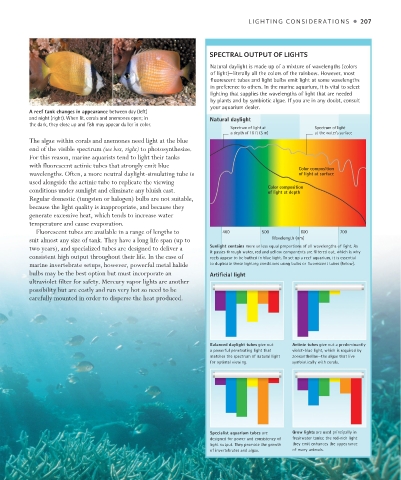
         A reef tank changes in appearance between day (left)
         and night (right). When lit, corals and anemones open; in   Natural daylight
         the dark, they close up and fish may appear duller in color.
                                                                 Spectrum of light at    Spectrum of light
                                                                 a depth of 16 ft (5 m)  at the water’s surface
         The algae within corals and anemones need light at the blue
         end of the visible spectrum (see box, right) to photosynthesize.
         For this reason, marine aquarists tend to light their tanks
         with fluorescent actinic tubes that strongly emit blue                    Color composition
         wavelengths. Often, a more neutral daylight-simulating tube is            of light at surface
         used alongside the actinic tube to replicate the viewing
         conditions under sunlight and eliminate any bluish cast.          Color composition
                                                                           of light at depth
         Regular domestic (tungsten or halogen) bulbs are not suitable,
         because the light quality is inappropriate, and because they
         generate excessive heat, which tends to increase water
         temperature and cause evaporation.
           Fluorescent tubes are available in a range of lengths to    400  500     600        700
         suit almost any size of tank. They have a long life span (up to    Wavelength (nm)
         two years), and specialized tubes are designed to deliver a   Sunlight contains more or less equal proportions of all wavelengths of light. As
         consistent high output throughout their life. In the case of   it passes through water, red and yellow components are filtered out, which is why
                                                           reefs appear to be bathed in blue light. To set up a reef aquarium, it is essential
         marine invertebrate setups, however, powerful metal halide   to duplicate these lighting conditions using bulbs or fluorescent tubes (below).
         bulbs may be the best option but must incorporate an    Artificial light
         ultraviolet filter for safety. Mercury vapor lights are another
         possibility but are costly and run very hot so need to be
         carefully mounted in order to disperse the heat produced.


                                                           Balanced daylight tubes give out    Actinic tubes give out a predominantly
                                                           a powerful penetrating light that   violet-blue light, which is required by
                                                           matches the spectrum of natural light   zooxanthellae—the algae that live
                                                           for optimal viewing.   symbiotically with corals.


                                                           Specialist aquarium tubes are   Grow lights are used principally in
                                                           designed for power and consistency of   freshwater tanks; the red-rich light
                                                           light output. They promote the growth   they emit enhances the appearance
                                                           of invertebrates and algae.  of many animals.


   US_206-207_Lighting_consider_V3.indd   207                                                        29/08/18   4:10 PM

