


Page 208 - Encyclopedia of Aquarium and Pond Fish, 3rd Edition
P. 208
206    MARINE FISH: SETTING UP THE TANK

         Lighting considerations


         Lighting the marine aquarium is both an art and
         a science. In an ideal setup, the light should appear
         natural and should enhance the colors and forms of
         the tank occupants, but it must also be of the correct
         intensity and quality to sustain life. Achieving this
         balance requires some planning, especially in reef tanks.

         The marine fishkeeper is presented with an apparently
         bewildering variety of lighting alternatives; choosing the right
         one depends largely on the types of marine organism housed
         in the aquarium. Most fish are tolerant of a wide range of
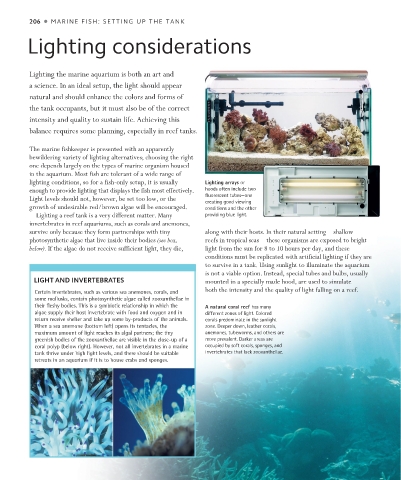
         lighting conditions, so for a fish-only setup, it is usually   Lighting arrays or
         enough to provide lighting that displays the fish most effectively.   hoods often include two
         Light levels should not, however, be set too low, or the   fluorescent tubes—one
                                                          creating good viewing
         growth of undesirable red/brown algae will be encouraged.  conditions and the other
           Lighting a reef tank is a very different matter. Many   providing blue light.
         invertebrates in reef aquariums, such as corals and anemones,
         survive only because they form partnerships with tiny   along with their hosts. In their natural setting—shallow
         photosynthetic algae that live inside their bodies (see box,    reefs in tropical seas—these organisms are exposed to bright
         below). If the algae do not receive sufficient light, they die,   light from the sun for 8 to 10 hours per day, and these
                                                          conditions must be replicated with artificial lighting if they are
                                                          to survive in a tank. Using sunlight to illuminate the aquarium
                                                          is not a viable option. Instead, special tubes and bulbs, usually
          LIGHT AND INVERTEBRATES                         mounted in a specially made hood, are used to simulate
           Certain invertebrates, such as various sea anemones, corals, and   both the intensity and the quality of light falling on a reef.
           some mollusks, contain photosynthetic algae called zooxanthellae in
           their fleshy bodies. This is a symbiotic relationship in which the   A natural coral reef has many
           algae supply their host invertebrate with food and oxygen and in   different zones of light. Colored
           return receive shelter and take up some by-products of the animals.   corals predominate in the sunlight
           When a sea anemone (bottom left) opens its tentacles, the   zone. Deeper down, leather corals,
           maximum amount of light reaches its algal partners; the tiny   anemones, tubeworms, and others are
           greenish bodies of the zooxanthellae are visible in the close-up of a   more prevalent. Darker areas are
           coral polyp (below right). However, not all invertebrates in a marine   occupied by soft corals, sponges, and
           tank thrive under high light levels, and there should be suitable   invertebrates that lack zooxanthellae.
           retreats in an aquarium if it is to house crabs and sponges.


   US_206-207_Lighting_consider_V3.indd   206                                                        29/08/18   4:10 PM

