


Page 206 - Encyclopedia of Aquarium and Pond Fish, 3rd Edition
P. 206
204    INTRODUCTION TO MARINE FISH

         the pitfalls of compatibility that can arise when fish are mixed
         with starfish, anemones, shrimp, or other invertebrates that
         may form their prey. In many other respects, the factors    DANGEROUS FISH  Spines inflict
         relating to the choice and siting of a marine tank are similar to   Some marine fish have    a burning,
                                                                                  painful sting
         those that apply to freshwater setups (see pp.30–31). The tank   powerful teeth that can
         itself may be glass or acrylic (the latter is lighter in weight but   inflict a painful bite or sharp
         scratches more easily). It must be sited on a suitable stand or   spines that can injure the
                                                           unwary fishkeeper. Other species
         piece of furniture on a strong, level floor, preferably adjacent   can inflict venomous stings that
         to a load-bearing wall and electrical outlets. The tank should   are not only dangerous to humans
         be located well away from windows, radiators, or any other   but can kill other tank inhabitants.
         environmental hazards and surrounded by an uncluttered area   In some cases, chemicals released
         to allow access for maintenance and water changes.  into the water cause toxic
                                                           poisoning of many or all of the
                                                           tank inhabitants. Although they
         Stocking the tank                                 may be highly decorative, these
         It is easy to make mistakes when stocking your marine tank,   fish, which include scorpion-, rock-,
         and a little research before buying will pay great dividends   and lionfish, as well as boxfish,
                                                           pufferfish, and squirrelfish, are probably
         later. As a general rule, start with a few inexpensive fish in    best avoided by novice aquarists.
         a fish-only tank—you can always graduate to a reef tank later.
         A great variety of species are available through the aquarium   Lionfish produce a venom that is a nerve
                                                           poison, or neurotoxin. When injected into a fish,
         trade, the majority of which are collected from the oceans   it paralyzes its muscles, including the heart.
         rather than raised in captivity. This can make some species
         hard to feed, because they are accustomed to live foods and
                                 reluctant to take substitute           of marine fish, unless they are of a species
                                 diets, even when these                 that has a distinctive juvenile pattern or
                                 contain all the ingredients           are clearly much smaller in size than adults
                                 needed to keep them in good          in the same tank.
                                 health. At first, avoid species
                                 with very specialized diets        Planning for the future
                                 (seahorses, for example, need      If you are setting up a community aquarium, try
                                 a diet based on brine shrimp       to select fish that occupy different areas or
                                 nauplii); instead, choose fish     levels within the tank, because this adds visual
                                 that can be kept on marine         interest, and also lessens the potential for
                                 flake or similar prepared          territorial disputes. The stocking levels in a
         Telling sexes apart is difficult in   foods, and, if possible,   marine aquarium need to be built up gradually
         most marine species; when buying    select tank-raised marine   (see p.216), so it is a good idea to plan the
         a shoal, you may well end up with    fish, such as clownfish,   evolution of your tank from the outset, taking
         a preponderance of males, which
         may display aggressive behavior.   which are particularly   into account the compatibility of fish to be
                                 easy to keep.                      introduced. Adding the fish in groups rather
         Buying policy                                              than haphazardly as individuals will help reduce
         If possible, try to view the fish yourself before buying;   the likelihood of bullying.
         this will allow you to make sure they are healthy and
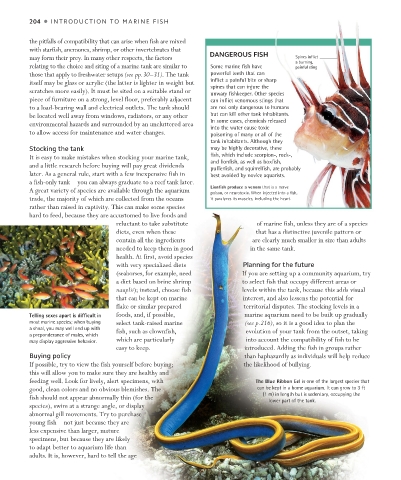
         feeding well. Look for lively, alert specimens, with           The Blue Ribbon Eel is one of the largest species that
         good, clean colors and no obvious blemishes. The               can be kept in a home aquarium. It can grow to 3 ft
         fish should not appear abnormally thin (for the                  (1 m) in length but is sedentary, occupying the
                                                                           lower part of the tank.
         species), swim at a strange angle, or display
         abnormal gill movements. Try to purchase
         young fish—not just because they are
         less expensive than larger, mature
         specimens, but because they are likely
         to adapt better to aquarium life than
         adults. It is, however, hard to tell the age


   US_202-205_What_to_consider.indd   204                                                            29/08/18   4:10 PM

