


Page 199 - Encyclopedia of Aquarium and Pond Fish, 3rd Edition
P. 199
SUBSTRATE PLANTS     197


          Ludwigia mullertii                                              Nymphoides aquatica
         Red Ludwigia                                                     Banana Plant

           ORIGINS  This plant does not grow naturally in the               ORIGINS  Occurs naturally in the eastern states of the
           wild, but its ancestors occur in North America.                  United States, extending along the Atlantic coastline.
           SIZE  Can grow to a height of 15 in (38 cm).                     SIZE  Can grow up to 12 in (30 cm).
           WATER  Temperature 68–86°F (20–30°C); soft                       WATER  Temperature 68–77°F (20–25°C); soft
           (50–100 mg/l) and around neutral (pH 6.5–7.5).                   (50–100 mg/l) and around neutral (pH 6.5–7.5).
           PROPAGATION  Very easily propagated from cuttings,               PROPAGATION  Divide the rootstock, remove
           although it may also be grown from seed.                         small plantlets, or split off runners.
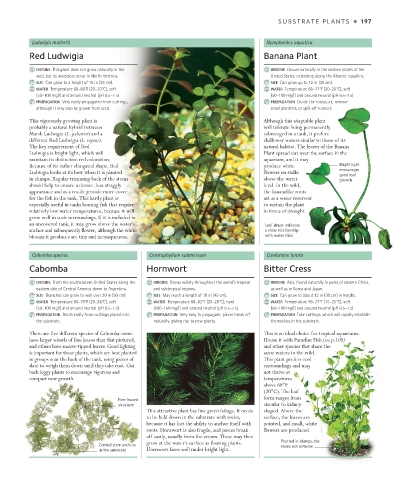
         This vigorously growing plant is                                 Although this adaptable plant
         probably a natural hybrid between                                will tolerate being permanently
         Marsh Ludwigia (L. palustris) and a                              submerged in a tank, it prefers
         different Red Ludwigia (L. repens).                              shallower waters similar to those of its
         The key requirement of Red                                       natural habitat. The leaves of the Banana
         Ludwigia is bright light, which will                             Plant spread out over the surface in the
         maintain its distinctive red coloration.                         aquarium, and it may
         Because of its rather elongated shape, Red                       produce white        Bright light
         Ludwigia looks at its best when it is planted                    flowers on stalks    encourages
                                                                                               good leaf
         in clumps. Regular trimming back of the stems                    above the water      growth
         should help to ensure a denser, less straggly                    level. In the wild,
         appearance and as a result provide more cover                    the bananalike roots
         for the fish in the tank. This hardy plant is                    act as a water reservoir
         especially useful in tanks housing fish that require             to sustain the plant
         relatively low water temperatures, because it will               in times of drought.
         grow well in such surroundings. If it is included in
         an uncovered tank, it may grow above the water’s                 Leaf shape indicates
         surface and subsequently flower, although the white              a close relationship
         blooms it produces are tiny and inconspicuous.                   with water lilies

          Cabomba species                 Ceratophyllum submersum         Cardamine lyrata
         Cabomba                         Hornwort                         Bitter Cress

           ORIGINS  From the southeastern United States along the   ORIGINS  Grows widely throughout the world’s tropical   ORIGINS  Asia, found naturally in parts of eastern China,
           eastern side of Central America down to Argentina.   and subtropical regions.  as well as in Korea and Japan.
           SIZE  Branches can grow to well over 20 in (50 cm).  SIZE  May reach a length of 18 in (45 cm).  SIZE  Can grow to about 12 in (30 cm) in height.
           WATER  Temperature 68–79°F (20–26°C); soft   WATER  Temperature 68–82°F (20–28°C); hard  WATER  Temperature 59–77°F (15–25°C); soft
           (50–100 mg/l) and around neutral (pH 6.5–7.2).  (100–150 mg/l) and around neutral (pH 6.5–7.5).  (50–100 mg/l) and around neutral (pH 6.5–7.5).
           PROPAGATION  Roots easily from cuttings placed into    PROPAGATION  Very easy to propagate; pieces break off   PROPAGATION  Take cuttings, which will rapidly establish
           the substrate.                  naturally, giving rise to new plants.  themselves in the substrate.
         There are five different species of Cabomba: some                This is an ideal choice for tropical aquariums.
         have larger whorls of fine leaves than that pictured,            House it with Paradise Fish (see p.108)
         and others have mauve-tipped leaves. Good lighting               and other species that share the
         is important for these plants, which are best planted            same waters in the wild.
         in groups near the back of the tank, using pieces of             This plant prefers cool
         slate to weigh them down until they take root. Cut               surroundings and may
         back leggy plants to encourage vigorous and                      not thrive at
         compact new growth.                                              temperatures
                                                                          above 68°F
                                                                          (20°C). The leaf
                                  Fine-leaved                             form ranges from
                                  structure                               circular to kidney-
                                         This attractive plant has fine green foliage. It needs   shaped. Above the
                                         to be held down in the substrate with rocks,   surface, the leaves are
                                         because it has lost the ability to anchor itself with   pointed, and small, white
                                         roots. Hornwort is also fragile, and pieces break   flowers are produced.
                                         off easily, usually from the crown. These may then
                            Central stem anchors   grow at the water’s surface as floating plants.   Planted in clumps, the
                                                                              stems will entwine
                            in the substrate  Hornwort fares well under bright light.


   US_196-197_Substrate_Plants.indd   197                                                            29/08/18   4:10 PM

