


Page 211 - Encyclopedia of Aquarium and Pond Fish, 3rd Edition
P. 211
SITING AND SUBSTRATE        209

                                 Avoid placing the aquarium
                                 where it will be exposed to
          SITING TIPS            direct sunlight, because you                           Acrylic admits about 15 percent
          •  Keep the tank clear of   will then lose control over                       more light than glass of
                                                                                        comparable thickness, and it can
          heaters, air-conditioning   the light intensity and                           be shaped into more unusual
                                                                                        forms with rounded corners.
          units, and windows. Sudden   temperature in the tank.
          changes in temperature can
          be lethal to fish.       Water and electricity don’t
          •  Be prepared to rearrange   mix, so it is essential to keep               Acrylic tanks are preferred
          the room decor to display the   cabling short and neat; avoid               by some marine aquarists.
          tank to best effect.   using messy extensions and                           They are lighter and easier
          •  Consider how easy it will   always consult a professional                to handle than glass, and
                                                                                      holes may be drilled through
          be to service the tank.  electrician if you have any                        them to conceal inlet and
          •  Place the tank on a   doubts about your system.                          outlet pipes. However, they
          completely level surface.                                                   do scratch more readily than
                                 Never plug pumps or filters                          conventional glass tanks
                                 into switched outlets—it                             and are more expensive.
         is all too easy inadvertently to flip the wrong wall switch
         and shut off the tank’s life support systems.

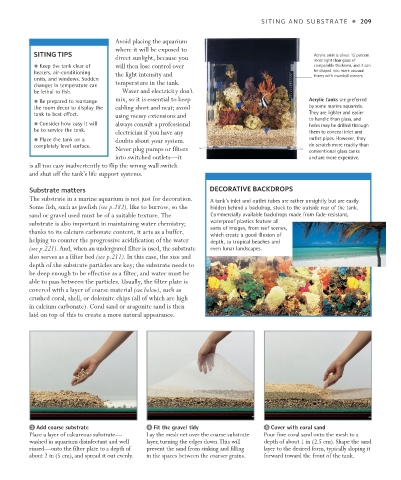
         Substrate matters                                 DECORATIVE BACKDROPS
         The substrate in a marine aquarium is not just for decoration.   A tank’s inlet and outlet tubes are rather unsightly but are easily
         Some fish, such as jawfish (see p.282), like to burrow, so the   hidden behind a backdrop, stuck to the outside rear of the tank.
         sand or gravel used must be of a suitable texture. The    Commercially available backdrops made from fade-resistant,
         substrate is also important in maintaining water chemistry;   waterproof plastics feature all
         thanks to its calcium carbonate content, it acts as a buffer,   sorts of images, from reef scenes,
                                                           which create a good illusion of
         helping to counter the progressive acidification of the water    depth, to tropical beaches and
         (see p.221). And, when an undergravel filter is used, the substrate   even lunar landscapes.
         also serves as a filter bed (see p.211). In this case, the size and
         depth of the substrate particles are key; the substrate needs to
         be deep enough to be effective as a filter, and water must be
         able to pass between the particles. Usually, the filter plate is
         covered with a layer of coarse material (see below), such as
         crushed coral, shell, or dolomite chips (all of which are high
         in calcium carbonate). Coral sand or aragonite sand is then
         laid on top of this to create a more natural appearance.


          1  Add coarse substrate         1  Fit the gravel tidy           1  Cover with coral sand
                                                                          5
                                          4
          3
         Place a layer of calcareous substrate—   Lay the mesh net over the coarse substrate   Pour fine coral sand onto the mesh to a
         washed in aquarium disinfectant and well   layer, turning the edges down. This will   depth of about 1 in (2.5 cm). Shape the sand
         rinsed—onto the filter plate to a depth of   prevent the sand from sinking and filling    layer to the desired form, typically sloping it
         about 2 in (5 cm), and spread it out evenly.  in the spaces between the coarser grains.  forward toward the front of the tank.


   US_208-209_Sitingand_Subtrate.indd   209                                                          29/08/18   4:10 PM

