


Page 212 - Encyclopedia of Aquarium and Pond Fish, 3rd Edition
P. 212
210    MARINE FISH: SETTING UP THE TANK

         Heating and filtration


         Tropical marine fish thrive at water temperatures of between 77°F (25°C)
         and 81°F (27°C). Their natural reef environment changes little from day
         to day, so they are poorly adapted to fluctuations in temperature and water
         quality. As a result, reef fish are far less tolerant of change than their
         freshwater cousins: creating and maintaining a constant environment
         is the key challenge when keeping such species in a home aquarium.

         Unless you live in a particularly
         warm climate, you will need a heater
         to maintain the water temperature in
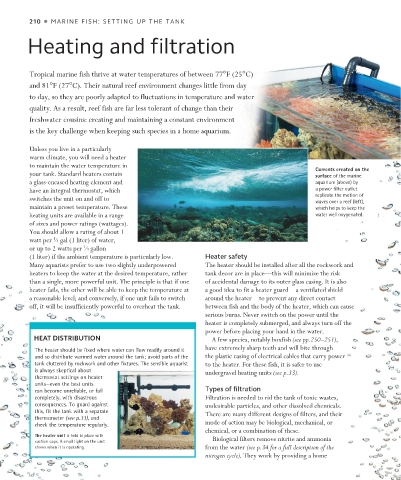
         your tank. Standard heaters contain                                            Currents created on the
                                                                                        surface of the marine
         a glass-encased heating element and                                            aquarium (above) by
         have an integral thermostat, which                                             a power filter outlet
         switches the unit on and off to                                                replicate the motion of
                                                                                        waves over a reef (left),
         maintain a preset temperature. These                                           which helps to keep the
         heating units are available in a range                                         water well oxygenated.
         of sizes and power ratings (wattages).
         You should allow a rating of about 1
                1
         watt per  ⁄4 gal (1 liter) of water,
                        1
         or up to 2 watts per  ⁄4 gallon
         (1 liter) if the ambient temperature is particularly low.    Heater safety
         Many aquarists prefer to use two slightly underpowered   The heater should be installed after all the rockwork and
         heaters to keep the water at the desired temperature, rather   tank decor are in place—this will minimize the risk
         than a single, more powerful unit. The principle is that if one   of accidental damage to its outer glass casing. It is also
         heater fails, the other will be able to keep the temperature at    a good idea to fit a heater guard—a ventilated shield
         a reasonable level; and conversely, if one unit fails to switch    around the heater—to prevent any direct contact
         off, it will be insufficiently powerful to overheat the tank.   between fish and the body of the heater, which can cause
                                                          serious burns. Never switch on the power until the
                                                          heater is completely submerged, and always turn off the
                                                          power before placing your hand in the water.
          HEAT DISTRIBUTION                                A few species, notably boxfish (see pp.250–251),

           The heater should be fixed where water can flow readily around it   have extremely sharp teeth and will bite through
           and so distribute warmed water around the tank; avoid parts of the   the plastic casing of electrical cables that carry power
           tank cluttered by rockwork and other fixtures. The sensible aquarist   to the heater. For these fish, it is safer to use
           is always skeptical about                      undergravel heating units (see p.33).
           thermostat settings on heater
           units—even the best units
           can become unreliable, or fail                 Types of filtration
           completely, with disastrous                    Filtration is needed to rid the tank of toxic wastes,
           consequences. To guard against                 undesirable particles, and other dissolved chemicals.
           this, fit the tank with a separate             There are many different designs of filters, and their
           thermometer (see p.33), and                    mode of action may be biological, mechanical, or
           check the temperature regularly.
                                                          chemical, or a combination of these.
           The heater unit is held in place with            Biological filters remove nitrite and ammonia
           suction caps. A small light on the unit
           shows when it is operating.                    from the water (see p.34 for a full description of the
                                                          nitrogen cycle). They work by providing a home


   US_210-211_Heating_Filtration.indd   210                                                          29/08/18   4:10 PM

