


Page 247 - Encyclopedia of Aquarium and Pond Fish, 3rd Edition
P. 247
CLOWNFISH    245


          Amphiprion clarkii
                                                                           MUTUAL BENEFITS
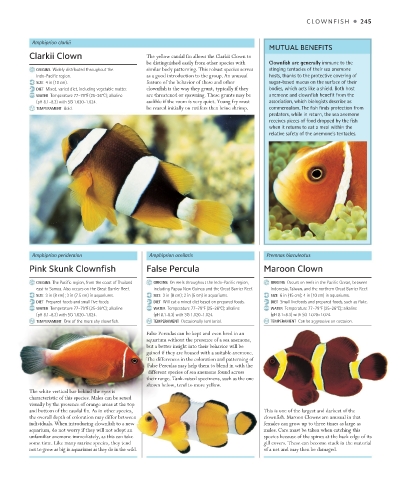
         Clarkii Clown                   The yellow caudal fin allows the Clarkii Clown to
                                         be distinguished easily from other species with   Clownfish are generally immune to the
           ORIGINS  Widely distributed throughout the    similar body patterning. This robust species serves   stinging tentacles of their sea anemone
           Indo-Pacific region.          as a good introduction to the group. An unusual   hosts, thanks to the protective covering of
           SIZE  4 in (10 cm).           feature of the behavior of these and other   sugar-based mucus on the surface of their
           DIET  Mixed, varied diet, including vegetable matter.  clownfish is the way they grunt, typically if they   bodies, which acts like a shield. Both host
           WATER  Temperature 77–79°F (25–26°C); alkaline    are threatened or spawning. These grunts may be   anemone and clownfish benefit from the
           (pH 8.1–8.3) with SG 1.020–1.024.  audible if the room is very quiet. Young fry must   association, which biologists describe as
           TEMPERAMENT  Bold.            be reared initially on rotifers then brine shrimp.  commensalism. The fish finds protection from
                                                                           predators, while in return, the sea anemone
                                                                           receives pieces of food dropped by the fish
                                                                           when it returns to eat a meal within the
                                                                           relative safety of the anemone’s tentacles.


          Amphiprion perideraion          Amphiprion ocellaris            Premnas biaculeatus
         Pink Skunk Clownfish            False Percula                    Maroon Clown

           ORIGINS  The Pacific region, from the coast of Thailand   ORIGINS  On reefs throughout the Indo-Pacific region,   ORIGINS  Occurs on reefs in the Pacific Ocean, between
           east to Samoa. Also occurs on the Great Barrier Reef.   including Papua New Guinea and the Great Barrier Reef.  Indonesia, Taiwan, and the northern Great Barrier Reef.
           SIZE  3 in (8 cm); 3 in (7.5 cm) in aquariums.   SIZE  3 in (8 cm); 2 in (5 cm) in aquariums.   SIZE  6 in (15 cm); 4 in (10 cm) in aquariums.
           DIET  Prepared foods and small live foods.  DIET  Will eat a mixed diet based on prepared foods.  DIET  Small livefoods and prepared foods, such as flake.
           WATER  Temperature 77–79°F (25–26°C); alkaline    WATER  Temperature 77–79°F (25 –26°C); alkaline    WATER  Temperature 77–79°F (25–26°C); alkaline
           (pH 8.1–8.3) with SG 1.020–1.024.  (pH 8.1-8.3) with SG 1.020–1.024.  (pH 8.1–8.3) with SG 1.020–1.024.
           TEMPERAMENT  One of the more shy clownfish.  TEMPERAMENT  Occasionally territorial.  TEMPERAMENT  Can be aggressive on occasion.
                                         False Perculas can be kept and even bred in an
                                         aquarium without the presence of a sea anemone,
                                         but a better insight into their behavior will be
                                         gained if they are housed with a suitable anemone.
                                         The differences in the coloration and patterning of
                                          False Perculas may help them to blend in with the
                                          different species of sea anemone found across
                                         their range. Tank-raised specimens, such as the one
                                         shown below, tend to more yellow.
         The white vertical bar behind the eyes is
         characteristic of this species. Males can be sexed
         visually by the presence of orange areas at the top
         and bottom of the caudal fin. As in other species,               This is one of the largest and darkest of the
         the overall depth of coloration may differ between               clownfish. Maroon Clowns are unusual in that
         individuals. When introducing clownfish to a new                 females can grow up to three times as large as
         aquarium, do not worry if they will not adopt an                 males. Care must be taken when catching this
         unfamiliar anemone immediately, as this can take                 species because of the spines at the back edge of its
         some time. Like many marine species, they tend                   gill covers. These can become stuck in the material
         not to grow as big in aquariums as they do in the wild.          of a net and may then be damaged.


   US_244-245_Clownfish.indd   245                                                                   29/08/18   4:10 PM

