


Page 249 - Encyclopedia of Aquarium and Pond Fish, 3rd Edition
P. 249
TRIGGERFISH     247


                                          Balistoides conspicillum        Sufflamen bursa
           TROUBLESOME TEETH
                                         Clown Triggerfish                Triggerfish
           Although triggerfish have small mouths,
           their powerful jaws have rows of teeth that   ORIGINS  From East Africa through the Pacific to Japan,   ORIGINS  Widely distributed throughout the
           can inflict a very painful bite. Take particular   Samoa, and the eastern side of Australia.  Indo-Pacific region.
           care when offering food directly, and always   SIZE  20 in (50 cm).  SIZE  10 in (25 cm).
           feed the fish before you put your hands into   DIET  Animal-based foods.  DIET  Omnivorous; very easy to feed.
           the tank to service it. A triggerfish is even   WATER  Temperature 77–79°F (25–26°C); alkaline   WATER  Temperature 77–79°F (25–26°C); alkaline
           capable of biting through the heater cable    (pH 8.2–8.4) with SG 1.023–1.027.  (pH 8.2–8.4) with SG 1.023–1.027.
           in the aquarium—electrocuting itself as a   TEMPERAMENT  Not to be trusted with other fish.  TEMPERAMENT  Antisocial.
           consequence—so protect cabling accordingly.
           In the wild, triggerfish rely on their powerful                A pale body, largely transparent fins, and two
           teeth to crush the shells of crustaceans,                      stripes on each side of the head identify this
           mollusks, and even coral, which they eat. They                 triggerfish. Males are more brightly colored than
           also communicate by grinding their teeth.                      females. Like related species, the Triggerfish is
                                                                          relatively tolerant in terms of water quality,
                                                                           but it needs an aquarium to itself. Start out
                                                                           with a lively juvenile of about 4 in (10 cm),
                                                                           which will be easier to tame.
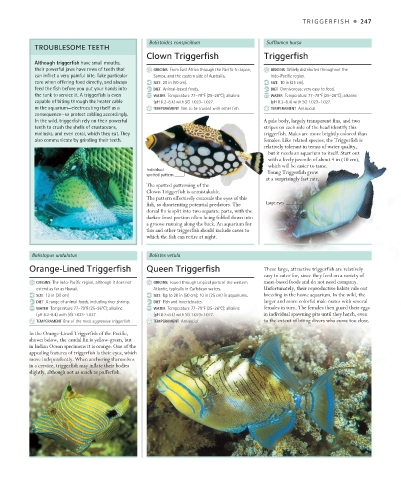
                                         Individual
                                         spotted pattern                   Young Triggerfish grow
                                                                          at a surprisingly fast rate.
                                         The spotted patterning of the
                                         Clown Triggerfish is unmistakable.
                                         The pattern effectively conceals the eyes of this
                                         fish, so disorienting potential predators. The   Large eyes
                                         dorsal fin is split into two separate parts, with the
                                         darker front portion often being folded down into
                                         a groove running along the back. An aquarium for
                                         this and other triggerfish should include caves to
                                         which the fish can retire at night.

          Balistapus undulatus            Balistes vetula
         Orange-Lined Triggerfish        Queen Triggerfish                These large, attractive triggerfish are relatively
                                                                          easy to cater for, since they feed on a variety of
           ORIGINS  The Indo-Pacific region, although it does not   ORIGINS  Found through tropical parts of the western   meat-based foods and do not need company.
           extend as far as Hawaii.        Atlantic, typically in Caribbean waters.   Unfortunately, their reproductive habits rule out
           SIZE  12 in (30 cm)             SIZE  Up to 20 in (50 cm); 10 in (25 cm) in aquariums.  breeding in the home aquarium. In the wild, the
           DIET  A range of animal foods, including river shrimp.  DIET  Fish and invertebrates.    larger and more colorful male mates with several
           WATER  Temperature 77–79°F (25–26°C); alkaline    WATER  Temperature 77–79°F (25–26°C); alkaline   females in turn. The females then guard their eggs
           (pH 8.2–8.4) with SG 1.023–1.027.   (pH 8.2–8.4) with SG 1.023–1.027.  in individual spawning pits until they hatch, even
           TEMPERAMENT One of the most aggressive triggerfish.  TEMPERAMENT  Antisocial.  to the extent of biting divers who come too close.
         In the Orange-Lined Triggerfish of the Pacific,
         shown below, the caudal fin is yellow-green, but
         in Indian Ocean specimens it is orange. One of the
         appealing features of triggerfish is their eyes, which
         move independently. When anchoring themselves
         in a crevice, triggerfish may inflate their bodies
         slightly, although not as much as pufferfish.


   US_246-247_Triggerfish.indd   247                                                                 29/08/18   4:10 PM

