


Page 252 - Encyclopedia of Aquarium and Pond Fish, 3rd Edition
P. 252
250    MARINE FISH DIRECTORY

         BOXFISH AND PORCUPINEFISH


         These fish have a distinctive appearance and can
         become surprisingly tame in aquarium surroundings.
         Characterized by a lack of streamlining, they cannot
         swim quickly to escape danger. They do, however,
         have other means of protection, such as the sharp
         spines of the porcupinefish. Take special care when
         catching and handling fish of this group, since many
         will release a poisonous mucus that, in the confines of
         an aquarium, will be deadly both to themselves and to
         the other tank inhabitants. The powerful jaws and teeth
         reflect their natural diet of marine crustaceans and
         mollusks. Aquarium specimens need similar foods in
         order to prevent their teeth from becoming overgrown.
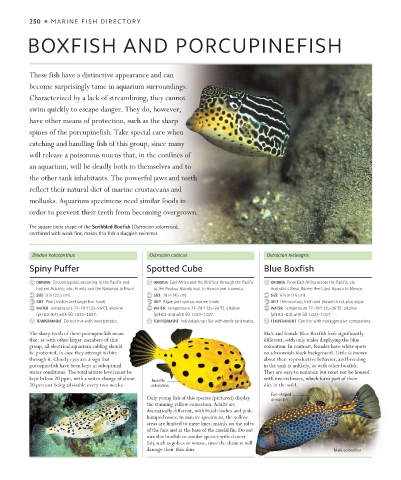
         The square body shape of the Scribbled Boxfish (Ostracion solorensis),
         combined with weak fins, makes this fish a sluggish swimmer.

          Diodon holocanthus              Ostracion cubicus               Ostracion meleagris
         Spiny Puffer                    Spotted Cube                     Blue Boxfish

           ORIGINS  Circumtropical, occurring in the Pacific and   ORIGINS  East Africa and the Red Sea through the Pacific   ORIGINS  From East Africa across the Pacific, via
           Eastern Atlantic; also Florida and the Bahamas to Brazil.  to the Ryukyu Islands, east to Hawaii and Tuamotu.   Australia’s Great Barrier Reef, and Hawaii to Mexico.
           SIZE  9 in (22.5 cm).           SIZE  18 in (45 cm).             SIZE  6 ⁄4 in (16 cm).
                                                                               1
           DIET  Plant matter and larger live foods.  DIET  Algae and various marine foods.  DIET  Omnivorous; fresh and thawed food, plus algae.
           WATER  Temperature 77–79°F (25–26°C); alkaline   WATER  Temperature 77–79°F (25–26°C); alkaline    WATER  Temperature 77–79°F (25–26°C); alkaline
           (pH 8.3–8.4) with SG 1.023–1.027.  (pH 8.3–8.4) with SG 1.023–1.027.   (pH 8.3–8.4) with SG 1.023–1.027.
           TEMPERAMENT  Do not mix with invertebrates.  TEMPERAMENT  Individuals can live with docile tankmates.  TEMPERAMENT  Can live with nonaggressive companions.
         The sharp teeth of these porcupinefish mean                      Male and female Blue Boxfish look significantly
         that, as with other larger members of this                       different, with only males displaying the blue
         group, all electrical aquarium cabling should                    coloration. In contrast, females have white spots
         be protected, in case they attempt to bite                       on a brownish-black background. Little is known
         through it. Cloudy eyes are a sign that                          about their reproductive behavior, and breeding
         porcupinefish have been kept in suboptimal                       in the tank is unlikely, as with other boxfish.
         water conditions. The total nitrate level must be                They are easy to maintain but must not be housed
         kept below 20 ppm, with a water change of about   Juvenile       with invertebrates, which form part of their
         20 percent being advisable every two weeks.  coloration          diet in the wild.
                                                                            Fan-shaped
                                         Only young fish of this species (pictured) display   dorsal fin
                                         the stunning yellow coloration. Adults are
                                         dramatically different, with bluish bodies and pink-
                                         humped noses. In mature specimens, the yellow
                                         areas are limited to mere lines, mainly on the sides
                                         of the face and at the base of the caudal fin. Do not
                                         mix this boxfish or similar species with cleaner
                                         fish, such as gobies or wrasse, since the cleaners will
                                         damage their thin skin.                             Male coloration


   US_250-251_Box_Cow_Pufferfish.indd   250                                                          29/08/18   4:10 PM

