


Page 270 - Encyclopedia of Aquarium and Pond Fish, 3rd Edition
P. 270
268    MARINE FISH DIRECTORY


          Bodianus anthioides
         Lyretail Hogfish

           ORIGINS  From the Red Sea eastward through much of
           the Pacific to Japan and New Caledonia.
           SIZE  10 in (25 cm).
           DIET  Primarily invertebrates.
           WATER  Temperature 77–79°F (25–26°C); alkaline
           (pH 8.0–8.3) with SG 1.020–1.025.
           TEMPERAMENT  Do not mix with invertebrates.
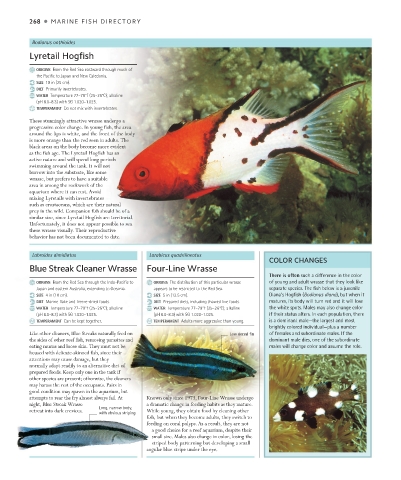
         These stunningly attractive wrasse undergo a
         progressive color change. In young fish, the area
         around the lips is white, and the front of the body
         is more orange than the red seen in adults. The
         black areas on the body become more evident
         as the fish age. The Lyretail Hogfish has an
         active nature and will spend long periods
         swimming around the tank. It will not
         burrow into the substrate, like some
         wrasse, but prefers to have a suitable
         area in among the rockwork of the
         aquarium where it can rest. Avoid
         mixing Lyretails with invertebrates
         such as crustaceans, which are their natural
         prey in the wild. Companion fish should be of a
         similar size, since Lyretail Hogfish are territorial.
         Unfortunately, it does not appear possible to sex
         these wrasse visually. Their reproductive
         behavior has not been documented to date.

          Labroides dimidiatus            Larabicus quadrilineatus
                                                                           COLOR CHANGES
         Blue Streak Cleaner Wrasse      Four-Line Wrasse
                                                                           There is often such a difference in the color
           ORIGINS  From the Red Sea through the Indo-Pacific to   ORIGINS  The distribution of this particular wrasse   of young and adult wrasse that they look like
           Japan and eastern Australia, extending to Oceania.   appears to be restricted to the Red Sea.   separate species. The fish below is a juvenile
           SIZE  4 in (10 cm).             SIZE  5 in (12.5 cm).           Diana’s Hogfish (Bodianus diana), but when it
           DIET  Marine flake and freeze-dried foods.   DIET  Prepared diets, including thawed live foods.   matures, its body will turn red and it will lose
           WATER  Temperature 77–79°F (25–26°C); alkaline   WATER  Temperature 77–79°F (25–26°C); alkaline  the white spots. Males may also change color
           (pH 8.0–8.3) with SG 1.020–1.025.   (pH 8.0–8.3) with SG 1.020–1.025.   if their status alters. In each population, there
           TEMPERAMENT  Can be kept together.  TEMPERAMENT  Adults more aggressive than young.  is a dominant male—the largest and most
                                                                           brightly colored individual—plus a number
         Like other cleaners, Blue Streaks naturally feed on    Low dorsal fin  of females and subordinate males. If the
         the sides of other reef fish, removing parasites and              dominant male dies, one of the subordinate
         eating mucus and loose skin. They must not be                     males will change color and assume the role.
         housed with delicate-skinned fish, since their
         attentions may cause damage, but they
         normally adapt readily to an alternative diet of
         prepared foods. Keep only one in the tank if
         other species are present; otherwise, the cleaners
         may harass the rest of the occupants. Pairs in
         good condition may spawn in the aquarium, but
         attempts to rear the fry almost always fail. At    Known only since 1973, Four-Line Wrasse undergo
         night, Blue Streak Wrasse       a dramatic change in feeding habits as they mature.
         retreat into dark crevices.  Long, narrow body,   While young, they obtain food by cleaning other
                            with obvious striping
                                         fish, but when they become adults, they switch to
                                         feeding on coral polyps. As a result, they are not
                                           a good choice for a reef aquarium, despite their
                                           small size. Males also change in color, losing the
                                           striped body patterning but developing a small
                                         angular blue stripe under the eye.


   US_268-269_Wrasse_Rainbowfish.indd   268                                                          29/08/18   4:10 PM

