


Page 271 - Encyclopedia of Aquarium and Pond Fish, 3rd Edition
P. 271
WRASSE    269


          Thalassoma jansenii             Thalassoma duperrey             Thalassoma hardwicke
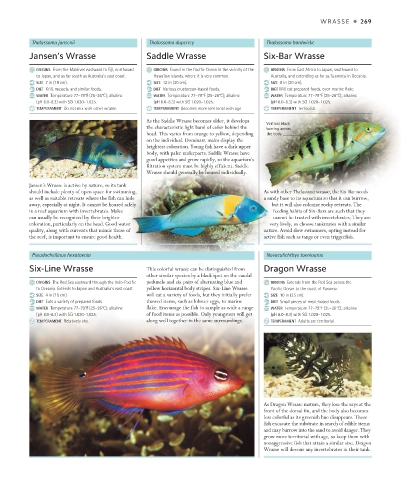
         Jansen’s Wrasse                 Saddle Wrasse                    Six-Bar Wrasse

           ORIGINS  From the Maldives eastward to Fiji, northward   ORIGINS  Found in the Pacific Ocean in the vicinity of the   ORIGINS  From East Africa to Japan, southward to
           to Japan, and as far south as Australia’s east coast.   Hawaiian islands, where it is very common.   Australia, and extending as far as Tuamotu in Oceania.
           SIZE  7 in (18 cm).             SIZE  12 in (30 cm).             SIZE  8 in (20 cm).
           DIET  Krill, mussels, and similar foods.   DIET  Various crustacean-based foods.  DIET Will eat prepared foods, even marine flake.
           WATER  Temperature 77–79°F (25–26°C); alkaline   WATER  Temperature 77–79°F (25–26°C); alkaline  WATER  Temperature 77–79°F (25–26°C); alkaline
           (pH 8.0–8.3) with SG 1.020–1.025.    (pH 8.0–8.3) with SG 1.020–1.025.   (pH 8.0–8.3) with SG 1.020–1.025.
           TEMPERAMENT  Do not mix with other wrasse.  TEMPERAMENT  Becomes more territorial with age.  TEMPERAMENT  Territorial.
                                         As the Saddle Wrasse becomes older, it develops   Vertical black
                                         the characteristic light band of color behind the   barring across
                                         head. This varies from orange to yellow, depending   the body
                                         on the individual. Dominant males display the
                                         brightest coloration. Young fish have a dark upper
                                         body, with paler underparts. Saddle Wrasse have
                                         good appetites and grow rapidly, so the aquarium’s
                                         filtration system must be highly efficient. Saddle
                                         Wrasse should generally be housed individually.
         Jansen’s Wrasse is active by nature, so its tank
         should include plenty of open space for swimming,                As with other Thalassoma wrasse, the Six-Bar needs
         as well as suitable retreats where the fish can hide             a sandy base to its aquarium so that it can burrow,
         away, especially at night. It cannot be housed safely              but it will also colonize rocky retreats. The
         in a reef aquarium with invertebrates. Males                       feeding habits of Six-Bars are such that they
         can usually be recognized by their brighter                        cannot be trusted with invertebrates. They are
         coloration, particularly on the head. Good water                  very lively, so choose tankmates with a similar
         quality, along with currents that mimic those of                 nature. Avoid slow swimmers, opting instead for
         the reef, is important to ensure good health.                    active fish such as tangs or even triggerfish.

          Pseudocheilinus hexataenia                                      Novaculichthys taeniourus
         Six-Line Wrasse                 This colorful wrasse can be distinguished from   Dragon Wrasse
                                         other similar species by a black spot on the caudal
           ORIGINS  The Red Sea eastward through the Indo-Pacific   peduncle and six pairs of alternating blue and   ORIGINS  Extends from the Red Sea across the
           to Oceania. Extends to Japan and Australia’s east coast.     yellow horizontal body stripes. Six-Line Wrasse   Pacific Ocean to the coast of Panama.
           SIZE  4 in (10 cm).           will eat a variety of foods, but they initially prefer   SIZE  10 in (25 cm).
           DIET  Eats a variety of prepared foods.  thawed items, such as lobster eggs, to marine   DIET  Small pieces of meat-based foods.
           WATER  Temperature 77–79°F (25–26°C); alkaline   flake. Encourage the fish to sample as wide a range   WATER  Temperature 77–79°F (25–26°C); alkaline
           (pH 8.0–8.3) with SG 1.020–1.025.   of food items as possible. Only youngsters will get    (pH 8.0–8.3) with SG 1.020–1.025.
           TEMPERAMENT  Relatively shy.  along well together in the same surroundings.  TEMPERAMENT  Adults are territorial.


                                                                          As Dragon Wrasse mature, they lose the rays at the
                                                                          front of the dorsal fin, and the body also becomes
                                                                          less colorful as its greenish hue disappears. These
                                                                          fish excavate the substrate in search of edible items
                                                                          and may burrow into the sand to avoid danger. They
                                                                          grow more territorial with age, so keep them with
                                                                          nonaggressive fish that attain a similar size. Dragon
                                                                          Wrasse will devour any invertebrates in their tank.


   US_268-269_Wrasse_Rainbowfish.indd   269                                                          29/08/18   4:10 PM

