


Page 272 - Encyclopedia of Aquarium and Pond Fish, 3rd Edition
P. 272
270    MARINE FISH DIRECTORY

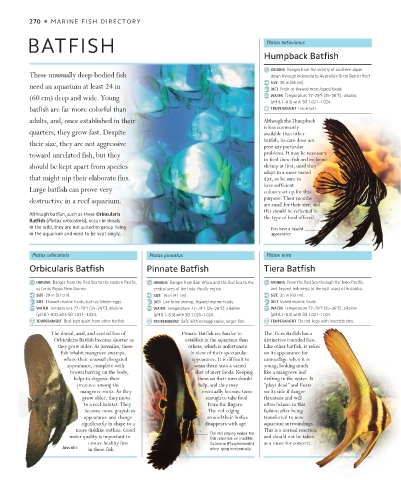
         BATFISH                                                          Platax batavianus

                                                                          Humpback Batfish

                                                                            ORIGINS  Ranges from the vicinity of southern Japan
         These unusually deep-bodied fish                                   down through Indonesia to Australia’s Great Barrier Reef.
         need an aquarium at least 24 in                                    SIZE  26 in (65 cm).
                                                                            DIET  Fresh or thawed meat-based foods.
         (60 cm) deep and wide. Young                                       WATER  Temperature 77–79°F (25–26°C); alkaline
                                                                            (pH 8.1–8.3) with SG 1.021–1.024.
         batfish are far more colorful than                                 TEMPERAMENT  Intolerant.
         adults, and, once established in their                           Although the Humpback
                                                                          is less commonly
         quarters, they grow fast. Despite                                available than other
         their size, they are not aggressive                              batfish, its care does not
                                                                          pose any particular
         toward unrelated fish, but they                                  problems. It may be necessary
                                                                          to feed these fish on live brine
         should be kept apart from species                                shrimp at first, until they
                                                                          adapt to a more varied
         that might nip their elaborate fins.                             diet, so be sure to
                                                                          have sufficient
         Large batfish can prove very                                     cultures set up for this
         destructive in a reef aquarium.                                  purpose. Their mouths
                                                                          are small for their size, and
                                                                          this should be reflected in
         Although batfish, such as these Orbicularis                      the type of food offered.
         Batfish (Platax orbicularis), occur in shoals
         in the wild, they are not suited to group living                   Fins have a tassled
         in the aquarium and need to be kept singly.                        appearance

          Platax orbicularis              Platax pinnatus                 Platax teira
         Orbicularis Batfish             Pinnate Batfish                  Tiera Batfish

           ORIGINS  Ranges from the Red Sea to the eastern Pacific,   ORIGINS  Ranges from East Africa and the Red Sea to the   ORIGINS  From the Red Sea through the Indo-Pacific,
           as far as Papua New Guinea.     central area of the Indo-Pacific region.   and beyond Indonesia to the east coast of Australia.
           SIZE  20 in (51 cm).            SIZE  16 in (41 cm).             SIZE  25 in (63 cm).
           DIET  Thawed marine foods, such as lobster eggs.  DIET  Live brine shrimp; thawed marine foods.  DIET  Varied marine foods.
           WATER  Temperature 77–79°F (25–26°C); alkaline   WATER  Temperature 77–79°F (25–26°C); alkaline   WATER  Temperature 77–79°F (25–26°C); alkaline
           (pH 8.1–8.3) with SG 1.021–1.024.   (pH 8.1–8.3) with SG 1.021–1.024.  (pH 8.1–8.3) with SG 1.021–1.024.
           TEMPERAMENT  Best kept apart from other batfish.  TEMPERAMENT  Safe with nonaggressive, larger fish.  TEMPERAMENT  Do not keep with invertebrates.
               The dorsal, anal, and ventral fins of   Pinnate Batfish are harder to   The Tiera Batfish has a
                Orbicularis Batfish become shorter as   establish in the aquarium than   distinctive rounded face.
                 they grow older. As juveniles, these   others, which is unfortunate    Like other batfish, it relies
                  fish inhabit mangrove swamps,       in view of their spectacular   on its appearance for
                   where their unusual elongated      appearance. It is difficult to   camouflage when it is
                    appearance, complete with          wean them onto a varied   young, looking much
                    brown barring on the body,         diet of inert foods. Keeping   like a mangrove leaf
                     helps to disguise their            them on their own should   drifting in the water. It
                      presence among the                help, and they may   “plays dead” and floats
                       mangrove roots. As they           eventually become tame   on its side if danger
                        grow older, they move             enough to take food   threatens and will
                        to a reef habitat. They           from the fingers.    often behave in this
                        become more grayish in            The red edging   fashion after being
                        appearance and change             around their bodies   transferred to new
                        significantly in shape to a       disappears with age.  aquarium surroundings.
                      more disklike outline. Good          The red edging makes the   This is a normal reaction,
                    water quality is important to          fish resemble an inedible   and should not be taken
                         ensure healthy fins               flatworm (Platyhelminth)   as a cause for concern.
                  Juvenile  in these fish.                 when lying horizontally


   US_270-271_Batfish_Seabass.indd   270                                                             29/08/18   4:10 PM

