


Page 274 - Encyclopedia of Aquarium and Pond Fish, 3rd Edition
P. 274
272    MARINE FISH DIRECTORY


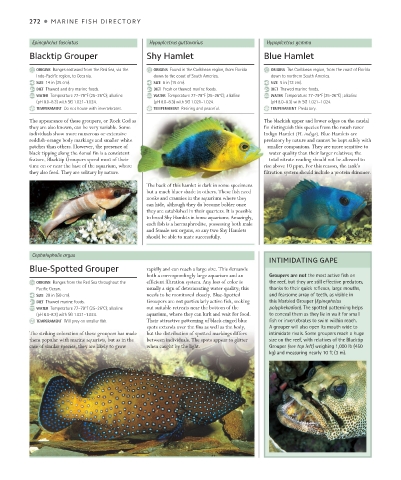
          Epinephelus fasciatus           Hypoplectrus guttavarius        Hypoplectrus gemma
         Blacktip Grouper                Shy Hamlet                       Blue Hamlet

           ORIGINS  Ranges eastward from the Red Sea, via the   ORIGINS  Found in the Caribbean region, from Florida   ORIGINS  The Caribbean region, from the coast of Florida
           Indo-Pacific region, to Oceania.   down to the coast of South America.  down to northern South America.
           SIZE  14 in (35 cm).            SIZE  6 in (15 cm).              SIZE  5 in (13 cm).
           DIET  Thawed and dry marine foods.  DIET  Fresh or thawed marine foods.  DIET  Thawed marine foods.
           WATER  Temperature 77–79°F (25–26°C); alkaline  WATER  Temperature 77–79°F (25–26°C); alkaline   WATER  Temperature 77–79°F (25–26°C); alkaline
           (pH 8.0–8.3) with SG 1.021–1.024.   (pH 8.0–8.3) with SG 1.021–1.024.  (pH 8.0–8.3) with SG 1.021–1.024.
           TEMPERAMENT  Do not house with invertebrates.  TEMPERAMENT  Retiring and peaceful.  TEMPERAMENT  Predatory.
         The appearance of these groupers, or Rock Cod as                 The blackish upper and lower edges on the caudal
         they are also known, can be very variable. Some                  fin distinguish this species from the much rarer
         individuals show more numerous or extensive                      Indigo Hamlet (H. indigo). Blue Hamlets are
         reddish-orange body markings and smaller white                   predatory by nature and cannot be kept safely with
         patches than others. However, the presence of                     smaller companions. They are more sensitive to
         black tipping along the dorsal fin is a consistent                water quality than their larger relatives; the
         feature. Blacktip Groupers spend most of their                    total nitrate reading should not be allowed to
         time on or near the base of the aquarium, where                  rise above 10 ppm. For this reason, the tank’s
         they also feed. They are solitary by nature.                     filtration system should include a protein skimmer.
                                         The back of this hamlet is dark in some specimens
                                         but a much bluer shade in others. These fish need
                                         nooks and crannies in the aquarium where they
                                         can hide, although they do become bolder once
                                         they are established in their quarters. It is possible
                                         to breed Shy Hamlets in home aquariums. Amazingly,
                                         each fish is a hermaphrodite, possessing both male
                                         and female sex organs, so any two Shy Hamlets
                                         should be able to mate successfully.

          Cephalopholis argus
                                                                           INTIMIDATING GAPE
         Blue-Spotted Grouper            rapidly and can reach a large size. This demands
                                         both a correspondingly large aquarium and an   Groupers are not the most active fish on
           ORIGINS  Ranges from the Red Sea throughout the   efficient filtration system. Any loss of color is   the reef, but they are still effective predators,
           Pacific Ocean.                usually a sign of deteriorating water quality; this   thanks to their quick reflexes, large mouths,
           SIZE  20 in (50 cm).          needs to be monitored closely. Blue-Spotted   and fearsome array of teeth, as visible in
           DIET  Thawed marine foods.    Groupers are not particularly active fish, seeking   this Marbled Grouper (Epinephelus
           WATER  Temperature 77–79°F (25–26°C); alkaline   out suitable retreats near the bottom of the   polyphekadion). The spotted patterning helps
           (pH 8.0–8.3) with SG 1.021–1.024.   aquarium, where they can lurk and wait for food.   to conceal them as they lie in wait for small
           TEMPERAMENT  Will prey on smaller fish.  Their attractive patterning of black-ringed blue   fish or invertebrates to swim within reach.
                                         spots extends over the fins as well as the body,    A grouper will also open its mouth wide to
         The striking coloration of these groupers has made   but the distribution of spotted markings differs   intimidate rivals. Some groupers reach a huge
         them popular with marine aquarists, but as in the   between individuals. The spots appear to glitter   size on the reef, with relatives of the Blacktip
         case of similar species, they are likely to grow    when caught by the light.  Grouper (see top left) weighing 1,000 lb (450
                                                                           kg) and measuring nearly 10 ft (3 m).


   US_272-273_Seabass_Grammas.indd   272                                                             29/08/18   4:10 PM

