


Page 276 - Encyclopedia of Aquarium and Pond Fish, 3rd Edition
P. 276
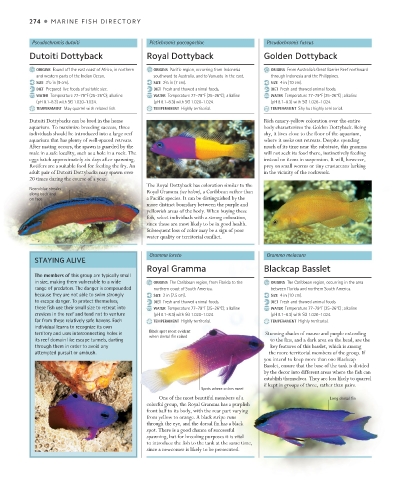
274    MARINE FISH DIRECTORY


          Pseudochromis dutoiti           Pictichromis paccagnellae       Pseudochromis fuscus
         Dutoiti Dottyback               Royal Dottyback                  Golden Dottyback

           ORIGINS  Found off the east coast of Africa, in northern   ORIGINS  Pacific region, occurring from Indonesia   ORIGINS  From Australia’s Great Barrier Reef northward
           and western parts of the Indian Ocean.  southward to Australia, and to Vanuatu in the east.  through Indonesia and the Philippines.
           SIZE  3 ⁄2 in (9 cm).           SIZE  2 ⁄4 in (7 cm).            SIZE  4 in (10 cm).
              1
                                               3
           DIET  Prepared live foods of suitable size.  DIET  Fresh and thawed animal foods.  DIET  Fresh and thawed animal foods.
           WATER  Temperature 77–79°F (25–26°C); alkaline   WATER  Temperature 77–79°F (25–26°C); alkaline   WATER  Temperature 77–79°F (25–26°C); alkaline
           (pH 8.1–8.3) with SG 1.020–1.024.   (pH 8.1–8.3) with SG 1.020–1.024.   (pH 8.1–8.3) with SG 1.020–1.024.
           TEMPERAMENT  May quarrel with related fish.  TEMPERAMENT  Highly territorial.  TEMPERAMENT  Shy but highly territorial.
         Dutoiti Dottybacks can be bred in the home                       Rich canary-yellow coloration over the entire
         aquarium. To maximize breeding success, three                    body characterizes the Golden Dottyback. Being
         individuals should be introduced into a large reef               shy, it lives close to the floor of the aquarium,
         aquarium that has plenty of well-spaced retreats.                where it seeks out retreats. Despite spending
         After mating occurs, the spawn is guarded by the                 much of its time near the substrate, this gramma
         male in a safe locality, such as a hole in a rock. The           will not seek its food there, instinctively feeding
         eggs hatch approximately six days after spawning.                instead on items in suspension. It will, however,
         Rotifers are a suitable food for feeding the fry. An             prey on small worms or tiny crustaceans lurking
         adult pair of Dutoiti Dottybacks may spawn over                  in the vicinity of the rockwork.
         20 times during the course of a year.
                                         The Royal Dottyback has coloration similar to the
         Neon-blue streaks
         along back and                  Royal Gramma (see below), a Caribbean rather than
         on face                         a Pacific species. It can be distinguished by the
                                         more distinct boundary between the purple and
                                         yellowish areas of the body. When buying these
                                         fish, select individuals with a strong coloration,
                                         since these are most likely to be in good health.
                                         Subsequent loss of color may be a sign of poor
                                         water quality or territorial conflict.

                                          Gramma loreto                   Gramma melacara
           STAYING ALIVE
                                         Royal Gramma                     Blackcap Basslet
           The members of this group are typically small
           in size, making them vulnerable to a wide   ORIGINS  The Caribbean region, from Florida to the   ORIGINS  The Caribbean region, occurring in the area
           range of predators. The danger is compounded   northern coast of South America.   between Florida and northern South America.
           because they are not able to swim strongly    SIZE  3 in (7.5 cm).  SIZE  4 in (10 cm).
           to escape danger. To protect themselves,    DIET  Fresh and thawed animal foods.  DIET  Fresh and thawed animal foods.
           these fish use their small size to retreat into   WATER  Temperature 77–79°F (25–26°C); alkaline   WATER  Temperature 77–79°F (25–26°C); alkaline
           crevices in the reef and tend not to venture   (pH 8.1–8.3) with SG 1.020–1.024.  (pH 8.1–8.3) with SG 1.020–1.024.
           far from these relatively safe havens. Each   TEMPERAMENT  Highly territorial.  TEMPERAMENT  Highly territorial.
           individual learns to recognize its own
           territory and uses interconnecting holes in    Black spot most evident   Stunning shades of mauve and purple extending
                                          when dorsal fin raised
           its reef domain like escape tunnels, darting                     to the fins, and a dark area on the head, are the
           through them in order to avoid any                               key features of this basslet, which is among
           attempted pursuit or ambush.                                    the more territorial members of the group. If
                                                                          you intend to keep more than one Blackcap
                                                                          Basslet, ensure that the base of the tank is divided
                                                                          by the decor into different areas where the fish can
                                                                          establish themselves. They are less likely to quarrel
                                                                          if kept in groups of three, rather than pairs.
                                                        Spots where colors meet
                                             One of the most beautiful members of a         Long dorsal fin
                                         colorful group, the Royal Gramma has a purplish
                                         front half to its body, with the rear part varying
                                         from yellow to orange. A black stripe runs
                                         through the eye, and the dorsal fin has a black
                                         spot. There is a good chance of successful
                                         spawning, but for breeding purposes it is vital
                                         to introduce the fish to the tank at the same time,
                                         since a newcomer is likely to be persecuted.


   US_274-275_Grammas_Blennies.indd   274                                                            29/08/18   4:10 PM

