


Page 278 - Encyclopedia of Aquarium and Pond Fish, 3rd Edition
P. 278
276    MARINE FISH DIRECTORY


          Meiacanthus atrodorsalis        Meiacanthus smithi              Ophioblennius atlanticus
         Forktail Blenny                 Smith’s Sawtail Blenny           Atlantic Fanged Blenny

           ORIGINS  The coast of East Africa through the Indo-   ORIGINS  Restricted to northern and western parts of the   ORIGINS  The Caribbean region, from Florida down to the
           Pacific, north to Japan and south to northern Australia.   Indian Ocean off the coast of East Africa.  northern coast of South America.
           SIZE  3 in (7.5 cm).            SIZE  3 ⁄2 in (9 cm).            SIZE  4 ⁄4 in (12 cm).
                                                                               3
                                               1
           DIET  Small live foods and algae.   DIET  Small live foods and algae.   DIET  Algae plus small live foods.
           WATER  Temperature 77–79°F (25–26°C); alkaline   WATER  Temperature 77–79°F (25–26°C); alkaline   WATER  Temperature 77–79°F (25–26°C); alkaline
           (pH 8.1–8.3) with SG 1.020–1.024.   (pH 8.1–8.3) with SG 1.020–1.024.   (pH 8.1–8.3) with SG 1.020–1.024.
           TEMPERAMENT  Not aggressive to unrelated fish.  TEMPERAMENT  Not aggressive to unrelated fish.  TEMPERAMENT  Highly territorial.
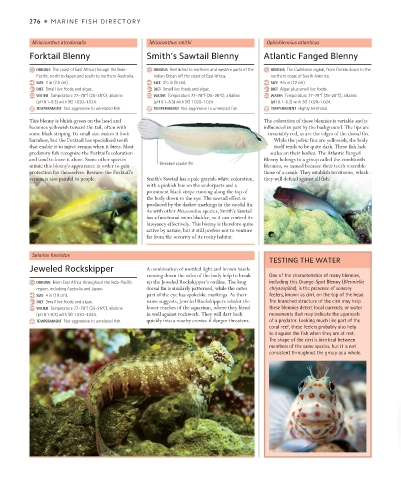
         This blenny is bluish-green on the head and                      The coloration of these blennies is variable and is
         becomes yellowish toward the tail, often with                    influenced in part by the background. The lips are
         some black striping. Its small size makes it look                 invariably red, as are the edges of the dorsal fin.
         harmless, but the Forktail has specialized teeth                    While the pelvic fins are yellowish, the body
         that enable it to inject venom when it bites. Most                  itself tends to be quite dark. These fish lack
         predatory fish recognize the Forktail’s coloration                 scales on their bodies. The Atlantic Fanged
         and tend to leave it alone. Some other species                   Blenny belongs to a group called the combtooth
         mimic this blenny’s appearance in order to gain   Streaked caudal fin  blennies, so named because their teeth resemble
         protection for themselves. Beware: the Forktail’s                those of a comb. They establish territories, which
         venom is also painful to people.  Smith’s Sawtail has a pale grayish-white coloration,   they will defend against all fish.
                                         with a pinkish hue on the underparts and a
                                         prominent black stripe running along the top of
                                         the body down to the eye. The sawtail effect is
                                         produced by the darker markings in the caudal fin.
                                         As with other Meiacanthus species, Smith’s Sawtail
                                         has a functional swim bladder, so it can control its
                                         buoyancy effectively. This blenny is therefore quite
                                         active by nature, but it still prefers not to venture
                                         far from the security of its rocky habitat.

          Salarias fasciatus
                                                                           TESTING THE WATER
         Jeweled Rockskipper             A combination of mottled light and brown bands
                                         running down the sides of the body help to break   One of the characteristics of many blennies,
           ORIGINS  From East Africa throughout the Indo-Pacific   up the Jeweled Rockskipper’s outline. The long   including this Orange-Spot Blenny (Blenniella
           region, including Australia and Japan.   dorsal fin is similarly patterned, while the outer   chrysospilos), is the presence of sensory
           SIZE  4 in (10 cm).           part of the eye has spokelike markings. As their   feelers, known as cirri, on the top of the head.
           DIET  Small live foods and algae.  name suggests, Jeweled Rockskippers inhabit the   The branched structure of the cirri may help
           WATER  Temperature 77–79°F (25–26°C); alkaline   lower reaches of the aquarium, where they blend   these blennies detect local currents, or water
           (pH 8.1–8.3) with SG 1.020 –1.024.   in well against rockwork. They will dart back   movements that may indicate the approach
           TEMPERAMENT  Not aggressive to unrelated fish.  quickly into a nearby crevice if danger threatens.  of a predator. Looking much like part of the
                                                                           coral reef, these feelers probably also help
                                                                           to disguise the fish when they are at rest.
                                                                           The shape of the cirri is identical between
                                                                           members of the same species, but it is not
                                                                           consistent throughout the group as a whole.


   US_276-277_Blennie_Rabbitfish.indd   276                                                          29/08/18   4:10 PM

