


Page 281 - Encyclopedia of Aquarium and Pond Fish, 3rd Edition
P. 281
HAWKFISH • SEA HORSES        279

         SEA HORSES                                                       Hippocampus kuda

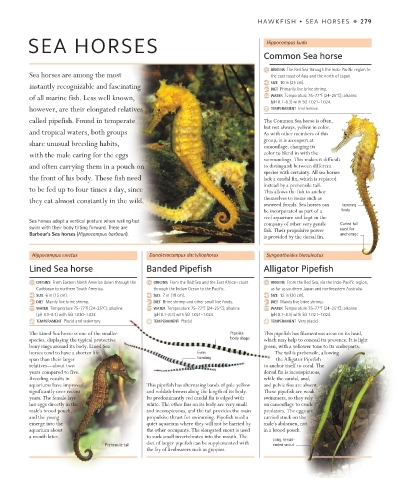
                                                                          Common Sea horse

                                                                            ORIGINS  The Red Sea through the Indo-Pacific region to
         Sea horses are among the most                                      the east coast of Asia and the north of Japan.
         instantly recognizable and fascinating                             SIZE  10 in (25 cm).
                                                                            DIET  Primarily live brine shrimp.
         of all marine fish. Less well known,                               WATER  Temperature 75–77°F (24–25°C); alkaline
                                                                            (pH 8.1–8.3) with SG 1.021–1.024.
         however, are their elongated relatives                             TEMPERAMENT  Inoffensive.
         called pipefish. Found in temperate                              The Common Sea horse is often,
                                                                          but not always, yellow in color.
         and tropical waters, both groups                                 As with other members of this
         share unusual breeding habits,                                   group, it is an expert at
                                                                          camouflage, changing its
         with the male caring for the eggs                                color to blend in with the
                                                                          surroundings. This makes it difficult
         and often carrying them in a pouch on                            to distinguish between different
                                                                          species with certainty. All sea horses
         the front of his body. These fish need                           lack a caudal fin, which is replaced
                                                                          instead by a prehensile tail.
         to be fed up to four times a day, since                          This allows the fish to anchor
         they eat almost constantly in the wild.                          themselves to items such as
                                                                          seaweed fronds. Sea horses can    Tapering
                                                                          be incorporated as part of a    body
                                                                          reef aquarium and kept in the
         Sea horses adopt a vertical posture when resting but             company of other very gentle   Curled tail
         swim with their body tilting forward. These are                  fish. Their propulsive power    used for
         Barbour’s Sea horses (Hippocampus barbouri).                                          anchorage
                                                                          is provided by the dorsal fin.
          Hippocampus erectus             Dunckerocampus dactyliophorus   Syngnathoides biaculeatus
         Lined Sea horse                 Banded Pipefish                  Alligator Pipefish

           ORIGINS  From Eastern North America down through the   ORIGINS  From the Red Sea and the East African coast   ORIGINS  From the Red Sea, via the Indo-Pacific region,
           Caribbean to northern South America.   through the Indian Ocean to the Pacific.  as far as southern Japan and northeastern Australia.
           SIZE  6 in (15 cm).             SIZE  7 in (18 cm).              SIZE  12 in (30 cm).
           DIET  Mainly live brine shrimp.   DIET  Brine shrimp and other small live foods.   DIET  Mainly live brine shrimp.
           WATER  Temperature 75–77°F (24 –25°C); alkaline   WATER  Temperature 75–77°F (24–25°C); alkaline   WATER  Temperature 75–77°F (24–25°C); alkaline
           (pH 8.1–8.3) with SG 1.020–1.024.  (pH 8.1–8.3) with SG 1.021–1.024.  (pH 8.1–8.3) with SG 1.021–1.024.
           TEMPERAMENT  Placid and sedentary.  TEMPERAMENT  Placid.         TEMPERAMENT  Very placid.
         The Lined Sea horse is one of the smaller               Pipelike   This pipefish has filamentous areas on its head,
         species, displaying the typical protective              body shape  which may help to conceal its presence. It is light
         bony rings around its body. Lined Sea                            green, with a yellower tone to its underparts.
         horses tend to have a shorter life            Even                  The tail is prehensile, allowing
         span than their larger                        banding               the Alligator Pipefish
         relatives—about two                                              to anchor itself to coral. The
         years compared to five.                                          dorsal fin is inconspicuous,
         Breeding results in                                              while the caudal, anal,
         aquariums have improved         This pipefish has alternating bands of pale yellow   and pelvic fins are absent.
         significantly over recent       and reddish-brown along the length of its body.    These pipefish are weak
         years. The female lays          Its predominantly red caudal fin is edged with   swimmers, so they rely
         her eggs directly in the        white. The other fins on its body are very small   on camouflage to evade
         male’s brood pouch,             and inconspicuous, and the tail provides the main   predators. The eggs are
         and the young                   propulsive thrust for swimming. Pipefish need a   carried stuck on the
         emerge into the                 quiet aquarium where they will not be harried by   male’s abdomen, not
         aquarium about                  the other occupants. The elongated snout is used   in a brood pouch.
         a month later.                  to suck small invertebrates into the mouth. The   Long, broad-
                                         diet of larger pipefish can be supplemented with
                              Prehensile tail                               ended snout
                                         the fry of livebearers such as guppies.


   US_278-279_Hawkfi_Seahorse.indd   279                                                            14/09/18   12:07 PM

