


Page 283 - Encyclopedia of Aquarium and Pond Fish, 3rd Edition
P. 283
OTHER POPULAR MARINE FISH    281


          Zanclus cornutus                Equetus lanceolatus             Pterapogon kauderni
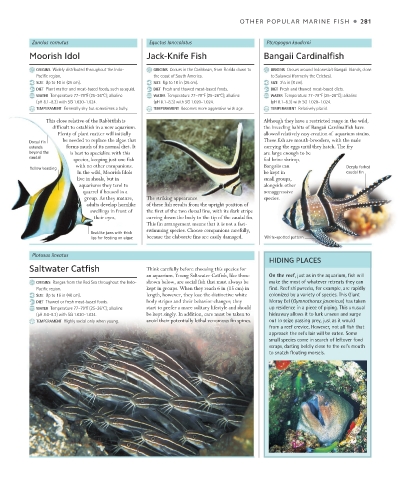
         Moorish Idol                    Jack-Knife Fish                  Bangaii Cardinalfish

           ORIGINS  Widely distributed throughout the Indo-   ORIGINS  Occurs in the Caribbean, from Florida down to   ORIGINS  Occurs around Indonesia’s Bangaii Islands, close
           Pacific region.                 the coast of South America.      to Sulawesi (formerly the Celebes).
                                                                               1
           SIZE  Up to 10 in (25 cm).      SIZE  Up to 10 in (25 cm).       SIZE  3 ⁄4 in (8 cm).
           DIET  Plant matter and meat-based foods, such as squid.  DIET  Fresh and thawed meat-based foods.  DIET  Fresh and thawed meat-based diets.
           WATER  Temperature 77–79°F (25–26°C); alkaline   WATER  Temperature 77–79°F (25–26°C); alkaline   WATER  Temperature 77–79°F (25–26°C); alkaline
           (pH 8.1–8.3) with SG 1.020–1.024.  (pH 8.1–8.3) with SG 1.020–1.024.  (pH 8.1–8.3) with SG 1.020–1.024.
           TEMPERAMENT  Generally shy but sometimes a bully.  TEMPERAMENT  Becomes more aggressive with age.  TEMPERAMENT  Relatively placid.
              This close relative of the Rabbitfish is                    Although they have a restricted range in the wild,
                difficult to establish in a new aquarium.                 the breeding habits of Bangaii Cardinalfish have
                 Plenty of plant matter will initially                    allowed relatively easy creation of  aquarium strains.
                  be needed to replace the algae that                     These fish are mouth-brooders, with the male
         Dorsal fin
         extends   forms much of its normal diet. It                      carrying the eggs until they hatch. The fry
         beyond the   is best to specialize with this                     are large enough to be
         caudal      species, keeping just one fish                       fed brine shrimp.
                      with no other companions.                           Bangaiis can
         Yellow banding                                                                          Deeply forked
                      In the wild, Moorish Idols                          be kept in             caudal fin
                      live in shoals, but in                              small groups,
                       aquariums they tend to                             alongside other
                        quarrel if housed in a                            nonaggressive
                        group. As they mature,   The striking appearance   species.
                         adults develop hornlike   of these fish results from the upright position of
                          swellings in front of   the first of the two dorsal fins, with its dark stripe
                           their eyes.   curving down the body to the tip of the caudal fin.
                                         This fin arrangement means that it is not a fast-
                                         swimming species. Choose companions carefully,
                          Beaklike jaws with thick
                          lips for feeding on algae  because the elaborate fins are easily damaged.  White-spotted pattern
          Plotosus lineatus
                                                                           HIDING PLACES
         Saltwater Catfish               Think carefully before choosing this species for
                                         an aquarium. Young Saltwater Catfish, like those   On the reef, just as in the aquarium, fish will
           ORIGINS  Ranges from the Red Sea throughout the Indo-   shown below, are social fish that must always be   make the most of whatever retreats they can
           Pacific region.               kept in groups. When they reach 6 in (15 cm) in   find. Reef shipwrecks, for example, are rapidly
           SIZE  Up to 16 in (40 cm).    length, however, they lose the distinctive white   colonized by a variety of species. This Giant
           DIET  Thawed or fresh meat-based foods.  body stripes and their behavior changes; they    Moray Eel (Gymnothorax javanicus) has taken
           WATER  Temperature 77–79°F (25–26°C); alkaline  start to prefer a more solitary lifestyle and should   up residence in a piece of piping. This unusual
           (pH 8.0–8.3) with SG 1.020–1.024.  be kept singly. In addition, care must be taken to   hideaway allows it to lurk unseen and surge
           TEMPERAMENT  Highly social only when young.  avoid their potentially lethal venomous fin spines.  out to seize passing prey, just as it would
                                                                           from a reef crevice. However, not all fish that
                                                                           approach the eel’s lair will be eaten. Some
                                                                           small species come in search of leftover food
                                                                           scraps, darting boldly close to the eel’s mouth
                                                                           to snatch floating morsels.


   US_280-281_Unusual_Marine_Fish.indd   281                                                         29/08/18   4:10 PM

