


Page 282 - Encyclopedia of Aquarium and Pond Fish, 3rd Edition
P. 282
280    MARINE FISH DIRECTORY

         OTHER POPULAR MARINE FISH


         A number of marine fish from other diverse
         groups are occasionally available to aquarists.
         Their requirements differ widely; some
         predatory species need a fish-only setup, while
         others can be housed safely in a reef aquarium.
         Never be tempted to choose a fish simply by its
         appearance. Make sure you can identify it with
         certainty, not only so that you can be sure of the
         size it is likely to reach as an adult, but also so
         that you can find out about its environmental
         needs and whether it will be compatible with
         other aquarium occupants. Bear in mind that
         juveniles are more commonly offered than adults.
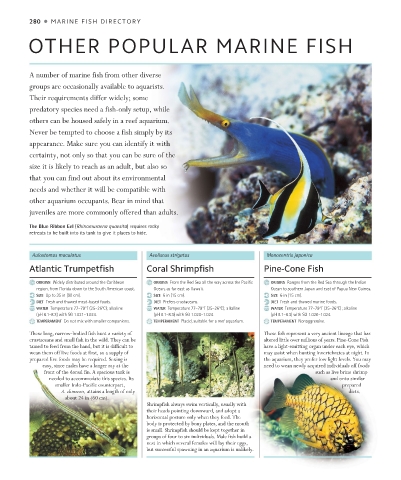
         The Blue Ribbon Eel (Rhinomuraena quaesita) requires rocky
         retreats to be built into its tank to give it places to hide.

          Aulostomus maculatus            Aeoliscus strigatus             Monocentris japonica
         Atlantic Trumpetfish            Coral Shrimpfish                 Pine-Cone Fish

           ORIGINS  Widely distributed around the Caribbean   ORIGINS  From the Red Sea all the way across the Pacific   ORIGINS  Ranges from the Red Sea through the Indian
           region, from Florida down to the South American coast.   Ocean, as far east as Hawaii.  Ocean to southern Japan and east of Papua New Guinea.
           SIZE  Up to 35 in (90 cm).      SIZE  6 in (15 cm).              SIZE  6 in (15 cm).
           DIET  Fresh and thawed meat-based foods.   DIET  Prefers crustaceans.  DIET  Fresh and thawed marine foods.
           WATER  Temperature 77–79°F (25–26°C); alkaline  WATER  Temperature 77–79°F (25–26°C); alkaline   WATER  Temperature 77–79°F (25–26°C); alkaline
           (pH 8.1–8.3) with SG 1.021–1.024.   (pH 8.1–8.3) with SG 1.020–1.024.   (pH 8.1–8.3) with SG 1.020–1.024.
           TEMPERAMENT  Do not mix with smaller companions.   TEMPERAMENT  Placid, suitable for a reef aquarium.  TEMPERAMENT  Nonaggressive.
         These long, narrow-bodied fish hunt a variety of                 These fish represent a very ancient lineage that has
         crustaceans and small fish in the wild. They can be              altered little over millions of years. Pine-Cone Fish
         tamed to feed from the hand, but it is difficult to              have a light-emitting organ under each eye, which
         wean them off live foods at first, so a supply of                may assist when hunting invertebrates at night. In
         prepared live foods may be required. Sexing is                   the aquarium, they prefer low light levels. You may
             easy, since males have a longer ray at the                   need to wean newly acquired individuals off foods
             front of the dorsal fin. A spacious tank is                                such as live brine shrimp
               needed to accommodate this species. Its                                      and onto similar
                smaller Indo-Pacific counterpart,                                              prepared
                  A. chinensis, attains a length of only                                         diets.
                   about 24 in (60 cm).
                                         Shrimpfish always swim vertically, usually with
                                         their heads pointing downward, and adopt a
                                         horizontal posture only when they feed. The
                                         body is protected by bony plates, and the mouth
                                         is small. Shrimpfish should be kept together in
                                         groups of four to six individuals. Male fish build a
                                         nest in which several females will lay their eggs,
                                         but successful spawning in an aquarium is unlikely.


   US_280-281_Unusual_Marine_Fish.indd   280                                                         29/08/18   4:10 PM

