


Page 285 - Encyclopedia of Aquarium and Pond Fish, 3rd Edition
P. 285
OTHER POPULAR MARINE FISH    283


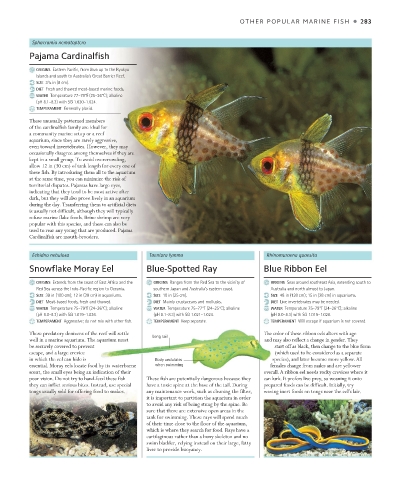
          Sphaeramia nematoptera
         Pajama Cardinalfish

           ORIGINS  Eastern Pacific, from Java up to the Ryukyu
           Islands and south to Australia’s Great Barrier Reef.
           SIZE  3 ⁄4 in (8 cm).
              1
           DIET  Fresh and thawed meat-based marine foods.
           WATER  Temperature 77–79°F (25–26°C); alkaline
           (pH 8.1–8.3) with SG 1.020–1.024.
           TEMPERAMENT  Generally placid.
         These unusually patterned members
         of the cardinalfish family are ideal for
         a community marine setup or a reef
         aquarium, since they are rarely aggressive,
         even toward invertebrates. However, they may
         occasionally disagree among themselves if they are
         kept in a small group. To avoid overcrowding,
         allow 12 in (30 cm) of tank length for every one of
         these fish. By introducing them all to the aquarium
         at the same time, you can minimize the risk of
         territorial disputes. Pajamas have large eyes,
         indicating that they tend to be most active after
         dark, but they will also prove lively in an aquarium
         during the day. Transferring them to artificial diets
         is usually not difficult, although they will typically
         refuse marine flake foods. Brine shrimp are very
         popular with this species, and these can also be
         used to rear any young that are produced. Pajama
         Cardinalfish are mouth-brooders.

          Echidna nebulosa                Taeniura lymma                  Rhinomuraena quaesita
         Snowflake Moray Eel             Blue-Spotted Ray                 Blue Ribbon Eel

           ORIGINS  Extends from the coast of East Africa and the   ORIGINS  Ranges from the Red Sea to the vicinity of   ORIGINS  Seas around southeast Asia, extending south to
           Red Sea across the Indo-Pacific region to Oceania.  southern Japan and Australia’s eastern coast.  Australia and north almost to Japan.
           SIZE  39 in (100 cm); 12 in (30 cm) in aquariums.   SIZE  10 in (25 cm).  SIZE  48 in (120 cm); 15 in (38 cm) in aquariums.
           DIET  Meat-based foods, fresh and thawed.  DIET  Mainly crustaceans and mollusks.  DIET  Live invertebrates may be needed.
           WATER  Temperature 75–79°F (24–26°C); alkaline   WATER  Temperature 75–77°F (24–25°C); alkaline   WATER  Temperature 75–79°F (24–26°C); alkaline
           (pH 8.0–8.3) with SG 1.019–1.026.  (pH 8.1–8.3) with SG 1.021–1.024.  (pH 8.0–8.3) with SG 1.019–1.026.
           TEMPERAMENT  Aggressive; do not mix with other fish.  TEMPERAMENT  Keep separate.  TEMPERAMENT  Will escape if aquarium is not covered.
         These predatory denizens of the reef will settle   Long tail     The color of these ribbon eels alters with age
         well in a marine aquarium. The aquarium must                     and may also reflect a change in gender. They
         be securely covered to prevent                                      start off as black, then change to the blue form
         escape, and a large crevice                                         (which used to be considered as a separate
         in which the eel can hide is       Body undulates                  species), and later become more yellow. All
         essential. Moray eels locate food by its waterborne   when swimming  females change from males and are yellower
         scent, the small eyes being an indication of their               overall. A ribbon eel needs rocky crevices where it
         poor vision. Do not try to hand-feed these fish—   These fish are potentially dangerous because they   can lurk. It prefers live prey, so weaning it onto
         they can inflict serious bites. Instead, use special   have a toxic spine at the base of the tail. During   prepared foods can be difficult. Initially, try
         tongs usually sold for offering food to snakes.  any maintenance work, such as cleaning the filter,   waving inert foods on tongs near the eel’s lair.
                                         it is important to partition the aquarium in order
                                         to avoid any risk of being stung by the spine. Be
                                         sure that there are extensive open areas in the
                                         tank for swimming. These rays will spend much
                                         of their time close to the floor of the aquarium,
                                         which is where they search for food. Rays have a
                                         cartilaginous rather than a bony skeleton and no
                                         swim bladder, relying instead on their large, fatty
                                         liver to provide buoyancy.


   US_282-283_Unusual_Marine_Fish.indd   283                                                         29/08/18   4:10 PM

