


Page 284 - Encyclopedia of Aquarium and Pond Fish, 3rd Edition
P. 284
282    MARINE FISH DIRECTORY


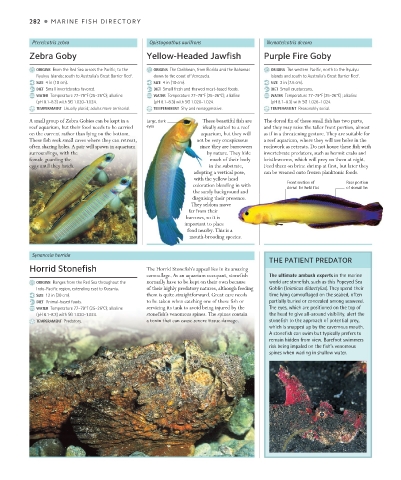
          Ptereleotris zebra              Opistognathus aurifrons         Nemateleotris decora
         Zebra Goby                      Yellow-Headed Jawfish            Purple Fire Goby

           ORIGINS  From the Red Sea across the Pacific, to the   ORIGINS  The Caribbean, from Florida and the Bahamas   ORIGINS  The western Pacific, north to the Ryukyu
           Ryukyu Islands; south to Australia’s Great Barrier Reef.  down to the coast of Venezuela.   Islands and south to Australia’s Great Barrier Reef.
           SIZE  4 in (10 cm).             SIZE  4 in (10 cm).              SIZE  3 in (7.5 cm).
           DIET  Small invertebrates favored.  DIET  Small fresh and thawed meat-based foods.  DIET  Small crustaceans.
           WATER  Temperature 77–79°F (25–26°C); alkaline   WATER  Temperature 77–79°F (25–26°C); alkaline   WATER  Temperature 77–79°F (25–26°C); alkaline
           (pH 8.1–8.3) with SG 1.020–1.024.   (pH 8.1–8.3) with SG 1.020–1.024.  (pH 8.1–8.3) with SG 1.020–1.024.
           TEMPERAMENT  Usually placid; adults more territorial.  TEMPERAMENT  Shy and nonaggressive.  TEMPERAMENT  Reasonably social.
         A small group of Zebra Gobies can be kept in a   Large, dark   These beautiful fish are   The dorsal fin of these small fish has two parts,
         reef aquarium, but their food needs to be carried   eyes  ideally suited to a reef   and they may raise the taller front portion, almost
         on the current rather than lying on the bottom.   aquarium, but they will   as if in a threatening gesture. They are suitable for
         These fish seek small caves where they can retreat,   not be very conspicuous    a reef aquarium, where they will use holes in the
         often sharing holes. A pair will spawn in aquarium   since they are burrowers    rockwork as retreats. Do not house these fish with
         surroundings, with the                           by nature. They hide   invertebrate predators, such as hermit crabs and
         female guarding the                               much of their body   bristleworms, which will prey on them at night.
         eggs until they hatch.                            in the substrate,   Feed them on brine shrimp at first, but later they
                                                      adopting a vertical pose,   can be weaned onto frozen planktonic foods.
                                                      with the yellow head
                                                      coloration blending in with   Front section of   Rear portion
                                                                                dorsal fin held flat
                                                                                                 of dorsal fin
                                                      the sandy background and
                                                      disguising their presence.
                                                      They seldom move
                                                     far from their
                                                    burrows, so it is
                                                    important to place
                                                     food nearby. This is a
                                                     mouth-brooding species.
          Synanceia horrida
                                                                           THE PATIENT PREDATOR
         Horrid Stonefish                The Horrid Stonefish’s appeal lies in its amazing
                                         camouflage. As an aquarium occupant, stonefish   The ultimate ambush experts in the marine
           ORIGINS  Ranges from the Red Sea throughout the    normally have to be kept on their own because    world are stonefish, such as this Popeyed Sea
           Indo-Pacific region, extending east to Oceania.  of their highly predatory natures, although feeding   Goblin (Inimicus didactylus). They spend their
           SIZE  12 in (30 cm).          them is quite straightforward. Great care needs    time lying camouflaged on the seabed, often
           DIET  Animal-based foods.     to be taken when catching one of these fish or   partially buried or concealed among seaweed.
           WATER  Temperature 77–79°F (25–26°C); alkaline   servicing its tank to avoid being injured by the   The eyes, which are positioned on the top of
           (pH 8.1–8.3) with SG 1.020–1.024.  stonefish’s venomous spines. The spines contain    the head to give all-around visibility, alert the
           TEMPERAMENT  Predatory.       a toxin that can cause severe tissue damage.  stonefish to the approach of potential prey,
                                                                           which is snapped up by the cavernous mouth.
                                                                           A stonefish can swim but typically prefers to
                                                                           remain hidden from view. Barefoot swimmers
                                                                           risk being impaled on the fish’s venomous
                                                                           spines when wading in shallow water.


   US_282-283_Unusual_Marine_Fish.indd   282                                                         29/08/18   4:10 PM

