


Page 294 - Encyclopedia of Aquarium and Pond Fish, 3rd Edition
P. 294
292    MARINE INVERTEBRATES DIRECTORY


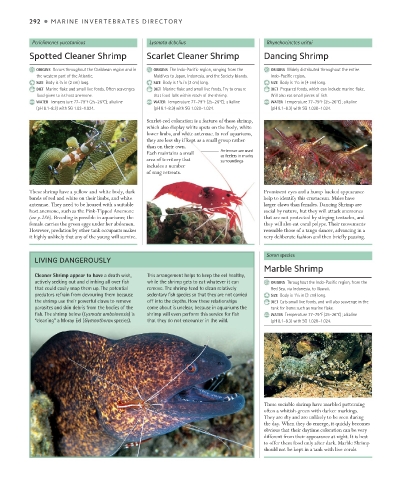
          Periclimenes yucatanicus        Lysmata debelius                Rhynchocinetes uritai
         Spotted Cleaner Shrimp          Scarlet Cleaner Shrimp           Dancing Shrimp

           ORIGINS  Occurs throughout the Caribbean region and in   ORIGINS  The Indo-Pacific region, ranging from the   ORIGINS  Widely distributed throughout the entire
           the western part of the Atlantic.   Maldives to Japan, Indonesia, and the Society Islands.  Indo-Pacific region.
           SIZE  Body is  ⁄4 in (2 cm) long.  SIZE  Body is 1 ⁄4 in (3 cm) long.  SIZE  Body is 1 ⁄2 in (4 cm) long.
                                                  1
                                                                                   1
                 3
           DIET  Marine flake and small live foods. Often scavenges   DIET  Marine flake and small live foods. Try to ensure   DIET  Prepared foods, which can include marine flake.
           food given to its host anemone.  that food falls within reach of the shrimp.  Will also eat small pieces of fish.
           WATER  Temperature 77–79°F (25–26°C); alkaline    WATER  Temperature 77–79°F (25–26°C); alkaline    WATER  Temperature 77–79°F (25–26°C); alkaline
           (pH 8.1–8.3) with SG 1.02– 1.024.  (pH 8.1–8.3) with SG 1.020–1.024.  (pH 8.1–8.3) with SG 1.020–1.024.
                                         Scarlet-red coloration is a feature of these shrimp,
                                         which also display white spots on the body, white
                                         lower limbs, and white antennae. In reef aquariums,
                                         they are less shy if kept as a small group rather
                                         than on their own.
                                         Each maintains a small   Antennae are used
                                                              as feelers in murky
                                         area of territory that   surroundings
                                         includes a number
                                         of snug retreats.
         These shrimp have a yellow-and-white body, dark                  Prominent eyes and a hump-backed appearance
         bands of red and white on their limbs, and white                 help to identify this crustacean. Males have
         antennae. They need to be housed with a suitable                 larger claws than females. Dancing Shrimp are
         host anemone, such as the Pink-Tipped Anemone                    social by nature, but they will attack anemones
         (see p.286). Breeding is possible in aquariums; the              that are not protected by stinging tentacles, and
         female carries the green eggs under her abdomen.                 they will also eat coral polyps. Their movements
         However, predation by other tank occupants makes                 resemble those of a tango dancer, advancing in a
         it highly unlikely that any of the young will survive.           very deliberate fashion and then briefly pausing.

                                                                          Saron species
           LIVING DANGEROUSLY
                                                                          Marble Shrimp
           Cleaner Shrimp appear to have a death wish,   This arrangement helps to keep the eel healthy,
           actively seeking out and climbing all over fish   while the shrimp gets to eat whatever it can   ORIGINS  Throughout the Indo-Pacific region, from the
           that could easily snap them up. The potential   remove. The shrimp tend to clean relatively   Red Sea, via Indonesia, to Hawaii.
           predators refrain from devouring them because   sedentary fish species so that they are not carried   SIZE  Body is 1 ⁄4 in (3 cm) long.
                                                                                   1
           the shrimp use their powerful claws to remove   off into the depths. How these relationships   DIET  Eats small live foods, and will also scavenge in the
           parasites and skin debris from the bodies of the   come about is unclear, because in aquariums the   tank for items such as marine flake.
           fish. The shrimp below (Lysmata amboinensis) is   shrimp will even perform this service for fish   WATER  Temperature 77–79°F (25–26°C); alkaline
           “cleaning” a Moray Eel (Gymnothorax species).   that they do not encounter in the wild.  (pH 8.1–8.3) with SG 1.020–1.024.


                                                                          These sociable shrimp have marbled patterning—
                                                                          often a whitish-green with darker markings.
                                                                          They are shy and are unlikely to be seen during
                                                                          the day. When they do emerge, it quickly becomes
                                                                          obvious that their daytime coloration can be very
                                                                          different from their appearance at night. It is best
                                                                          to offer them food only after dark. Marble Shrimp
                                                                          should not be kept in a tank with live corals.


   US_292-293_Crustaceans_2.indd   292                                                               29/08/18   4:10 PM

