


Page 295 - Encyclopedia of Aquarium and Pond Fish, 3rd Edition
P. 295
CRUSTACEANS    293


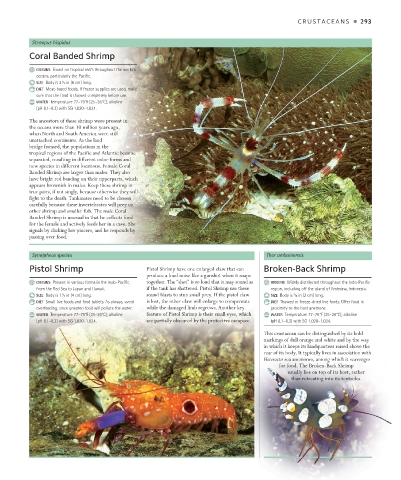
          Stenopus hispidus
         Coral Banded Shrimp

           ORIGINS  Found on tropical reefs throughout the world’s
           oceans, particularly the Pacific.
           SIZE  Body is 2 ⁄2 in (6 cm) long.
                  1
           DIET  Meat-based foods. If frozen supplies are used, make
           sure that the food is thawed completely before use.
           WATER  Temperature 77–79°F (25–26°C); alkaline
           (pH 8.1–8.3) with SG 1.020–1.024.
         The ancestors of these shrimp were present in
         the oceans more than 10 million years ago,
         when North and South America were still
         unattached continents. As the land
         bridge formed, the populations in the
         tropical regions of the Pacific and Atlantic became
         separated, resulting in different color forms and
         new species in different locations. Female Coral
         Banded Shrimp are larger than males. They also
         have bright red banding on their upperparts, which
         appears brownish in males. Keep these shrimp in
         true pairs, if not singly, because otherwise they will
         fight to the death. Tankmates need to be chosen
         carefully because these invertebrates will prey on
         other shrimp and smaller fish. The male Coral
         Banded Shrimp is unusual in that he collects food
         for the female and actively feeds her in a cave. She
         signals by clicking her pincers, and he responds by
         passing over food.

          Synalpheus species                                              Thor amboinensis
         Pistol Shrimp                   Pistol Shrimp have one enlarged claw that can   Broken-Back Shrimp
                                         produce a loud noise like a gunshot when it snaps
           ORIGINS  Present in various forms in the Indo-Pacific,   together. The “shot” is so loud that it may sound as   ORIGINS  Widely distributed throughout the Indo-Pacific
           from the Red Sea to Japan and Hawaii.   if the tank has shattered. Pistol Shrimp use these   region, including off the island of Amboina, Indonesia.
           SIZE  Body is 1 ⁄2 in (4 cm) long.  sound blasts to stun small prey. If the pistol claw    SIZE  Body is  ⁄4 in (2 cm) long.
                  1
                                                                                  3
           DIET  Small live foods and food tablets. As always, avoid   is lost, the other claw will enlarge to compensate   DIET  Thawed or freeze-dried live foods. Offer food in
           overfeeding, since uneaten food will pollute the water.  while the damaged limb regrows. Another key   proximity to the host anemone.
           WATER  Temperature 77–79°F (25–26°C); alkaline    feature of Pistol Shrimp is their small eyes, which   WATER  Temperature 77–79°F (25–26°C); alkaline
           (pH 8.1–8.3) with SG 1.020–1.024.  are partially obscured by the protective carapace.  (pH 8.1–8.3) with SG 1.020–1.024.
                                                                          This crustacean can be distinguished by its bold
                                                                          markings of dull orange and white and by the way
                                                                          in which it keeps its hindquarters raised above the
                                                                          rear of its body. It typically lives in association with
                                                                          Heteractis sea anemones, among which it scavenges
                                                                              for food. The Broken-Back Shrimp
                                                                                usually lies on top of its host, rather
                                                                                 than retreating into its tentacles.


   US_292-293_Crustaceans_2.indd   293                                                               29/08/18   4:10 PM

