


Page 296 - Encyclopedia of Aquarium and Pond Fish, 3rd Edition
P. 296
294    MARINE INVERTEBRATES DIRECTORY

         MOLLUSKS AND ANNELIDS


         There are few more diverse invertebrate groups than
         the mollusks. Marine gastropod mollusks possess a
         protective shell and a “foot” for locomotion, just like
         the land snails. Bivalves, such as clams, have a two-part,
         hinged shell and a more sedentary lifestyle. The
         shell-less sea slugs can be difficult to maintain in
         aquariums, because their dietary requirements
         are so specific. Cephalopods, which include
         squid and octopuses, can also be problematic,
         since they require large tanks and are extremely
         sensitive to water conditions. Annelids, in
         contrast, are a group of segmented worms.
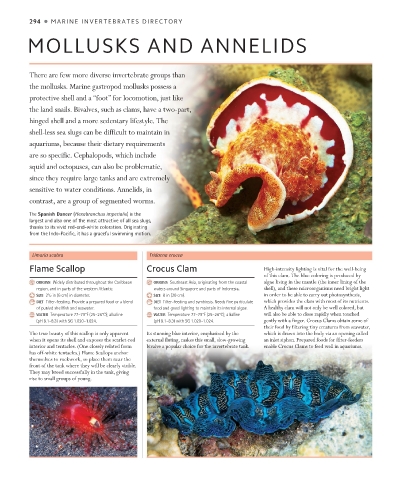
         The Spanish Dancer (Hexabranchus imperialis) is the
         largest and also one of the most attractive of all sea slugs,
         thanks to its vivid red-and-white coloration. Originating
         from the Indo-Pacific, it has a graceful swimming motion.

          Limaria scabra                  Tridacna crocea
         Flame Scallop                   Crocus Clam                      High-intensity lighting is vital for the well-being
                                                                          of this clam. The blue coloring is produced by
           ORIGINS  Widely distributed throughout the Caribbean   ORIGINS  Southeast Asia, originating from the coastal   algae living in the mantle (the inner lining of the
           region, and in parts of the western Atlantic.  waters around Singapore and parts of Indonesia.  shell), and these microorganisms need bright light
           SIZE  2 ⁄2 in (6 cm) in diameter.  SIZE  8 in (20 cm).         in order to be able to carry out photosynthesis,
              1
           DIET  Filter-feeding. Provide a prepared food or a blend   DIET  Filter-feeding and symbiosis. Needs fine particulate   which provides the clam with most of its nutrients.
           of puréed shellfish and seawater.  food and good lighting to maintain its internal algae.  A healthy clam will not only be well colored, but
           WATER  Temperature 77–79°F (25–26°C); alkaline   WATER  Temperature 77–79°F (25–26°C); alkaline   will also be able to close rapidly when touched
           (pH 8.1–8.3) with SG 1.020–1.024.  (pH 8.1–8.3) with SG 1.020–1.024.  gently with a finger. Crocus Clams obtain some of
                                                                          their food by filtering tiny creatures from seawater,
         The true beauty of this scallop is only apparent   Its stunning blue interior, emphasized by the   which is drawn into the body via an opening called
         when it opens its shell and exposes the scarlet-red   external fluting, makes this small, slow-growing   an inlet siphon. Prepared foods for filter-feeders
         interior and tentacles. (One closely related form   bivalve a popular choice for the invertebrate tank.   enable Crocus Clams to feed well in aquariums.
         has off-white tentacles.) Flame Scallops anchor
         themselves to rockwork, so place them near the
         front of the tank where they will be clearly visible.
         They may breed successfully in the tank, giving
         rise to small groups of young.


   US_294-295_Molluscs_Annelids.indd   294                                                           29/08/18   4:10 PM

