


Page 297 - Encyclopedia of Aquarium and Pond Fish, 3rd Edition
P. 297
MOLLUSKS AND ANNELIDS    295


          Sabellastarte magnifica         Octopus cyanea                  Lobatus gigas
         Featherduster Worm              Common Tropical Octopus          Queen Conch

           ORIGINS  Occurs widely throughout the tropical western   ORIGINS  Coral reefs off Asia and throughout the Indo-   ORIGINS  The Caribbean region, including the Florida
           Atlantic and the Caribbean region.   Pacific region, especially off Indonesia.  coast and around the Bahamas.
           SIZE  4 in (10 cm).             SIZE  12 in (30 cm).             SIZE  10 in (25 cm).
           DIET  Filter-feeding. Use prepared food, or a blend of   DIET  Fish and crustaceans, which must be fully thawed if   DIET  Marine algae and scavenged waste matter.
           puréed shellfish and seawater.  frozen. Feed according to appetite each day.  Place food within easy reach of the conch.
           WATER  Temperature 77–79°F (25–26°C); alkaline   WATER  Temperature 77–79°F (25–26°C); alkaline   WATER  Temperature 77–79°F (25–26°C); alkaline
           (pH 8.1–8.3) with SG 1.020–1.024.  (pH 8.1–8.3) with SG 1.020–1.024.  (pH 8.1–8.3) with SG 1.020–1.024.
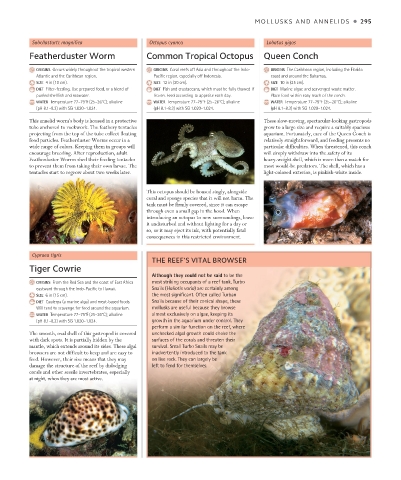
         This annelid worm’s body is housed in a protective               These slow-moving, spectacular-looking gastropods
         tube anchored to rockwork. The feathery tentacles                grow to a large size and require a suitably spacious
         projecting from the top of the tube collect floating             aquarium. Fortunately, care of the Queen Conch is
         food particles. Featherduster Worms occur in a                   relatively straightforward, and feeding presents no
         wide range of colors. Keeping them in groups will                particular difficulties. When threatened, this conch
         encourage breeding. After reproduction, adult                    will simply withdraw into the safety of its
         Featherduster Worms shed their feeding tentacles                 heavy-weight shell, which is more than a match for
         to prevent them from taking their own larvae. The                most would-be predators. The shell, which has a
         tentacles start to regrow about two weeks later.                 light-colored exterior, is pinkish-white inside.

                                         This octopus should be housed singly, alongside
                                         coral and sponge species that it will not harm. The
                                         tank must be firmly covered, since it can escape
                                         through even a small gap in the hood. When
                                         introducing an octopus to new surroundings, leave
                                         it undisturbed and without lighting for a day or
                                         so, or it may eject its ink, with potentially fatal
                                         consequences in this restricted environment.

          Cypraea tigris
                                           THE REEF’S VITAL BROWSER
         Tiger Cowrie
                                           Although they could not be said to be the
           ORIGINS  From the Red Sea and the coast of East Africa   most striking occupants of a reef tank, Turbo
           eastward through the Indo-Pacific to Hawaii.  Snails (Haliotis varia) are certainly among
           SIZE  6 in (15 cm).             the most significant. Often called Turban
           DIET  Caulerpa (a marine alga) and meat-based foods.   Snails because of their conical shape, these
           Will tend to scavenge for food around the aquarium.  mollusks are useful because they browse
           WATER  Temperature 77–79°F (25–26°C); alkaline    almost exclusively on algae, keeping its
           (pH 8.1–8.3) with SG 1.020–1.024.  growth in the aquarium under control. They
                                           perform a similar function on the reef, where
         The smooth, oval shell of this gastropod is covered   unchecked algal growth could choke the
         with dark spots. It is partially hidden by the   surfaces of the corals and threaten their
         mantle, which extends around its sides. These algal   survival. Small Turbo Snails may be
         browsers are not difficult to keep and are easy to   inadvertently introduced to the tank
         feed. However, their size means that they may   on live rock. They can largely be
         damage the structure of the reef by dislodging   left to fend for themselves.
         corals and other sessile invertebrates, especially
         at night, when they are most active.


   US_294-295_Molluscs_Annelids.indd   295                                                           29/08/18   4:10 PM

