


Page 325 - Encyclopedia of Aquarium and Pond Fish, 3rd Edition
P. 325
HEALTH CONCERNS    323


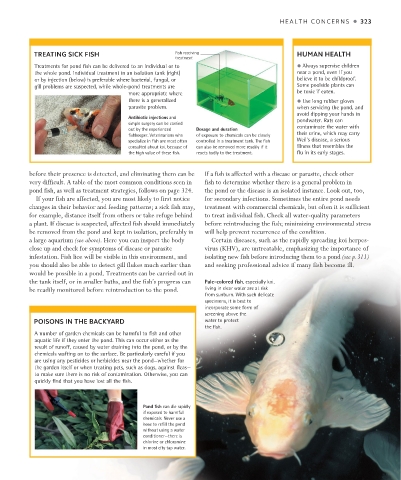
          TREATING SICK FISH                     Fish receiving                    HUMAN HEALTH
                                                 treatment
           Treatments for pond fish can be delivered to an individual or to        •  Always supervise children
           the whole pond. Individual treatment in an isolation tank (right)       near a pond, even if you
           or by injection (below) is preferable where bacterial, fungal, or       believe it to be childproof.
           gill problems are suspected, while whole-pond treatments are            Some poolside plants can
                                    more appropriate where                         be toxic if eaten.
                                    there is a generalized                         •  Use long rubber gloves
                                    parasite problem.                              when servicing the pond, and
                                                                                   avoid dipping your hands in
                                    Antibiotic injections and                      pondwater. Rats can
                                    simple surgery can be carried
                                    out by the experienced   Dosage and duration    contaminate the water with
                                    fishkeeper. Veterinarians who   of exposure to chemicals can be closely   their urine, which may carry
                                    specialize in fish are most often   controlled in a treatment tank. The fish    Weil’s disease, a serious
                                    consulted about koi, because of   can also be removed more readily if it    illness that resembles the
                                    the high value of these fish.  reacts badly to the treatment.  flu in its early stages.

         before their presence is detected, and eliminating them can be   If a fish is affected with a disease or parasite, check other
         very difficult. A table of the most common conditions seen in   fish to determine whether there is a general problem in
         pond fish, as well as treatment strategies, follows on page 324.  the pond or the disease is an isolated instance. Look out, too,
           If your fish are affected, you are most likely to first notice   for secondary infections. Sometimes the entire pond needs
         changes in their behavior and feeding patterns; a sick fish may,   treatment with commercial chemicals, but often it is sufficient
         for example, distance itself from others or take refuge behind   to treat individual fish. Check all water-quality parameters
         a plant. If disease is suspected, affected fish should immediately   before reintroducing the fish; minimizing environmental stress
         be removed from the pond and kept in isolation, preferably in   will help prevent recurrence of the condition.
         a large aquarium (see above). Here you can inspect the body   Certain diseases, such as the rapidly spreading koi herpes-
         close up and check for symptoms of disease or parasite   virus (KHV), are untreatable, emphasizing the importance of
         infestation. Fish lice will be visible in this environment, and   isolating new fish before introducing them to a pond (see p.311)
         you should also be able to detect gill flukes much earlier than   and seeking professional advice if many fish become ill.
         would be possible in a pond. Treatments can be carried out in
         the tank itself, or in smaller baths, and the fish’s progress can   Pale-colored fish, especially koi,
         be readily monitored before reintroduction to the pond.   living in clear water are at risk
                                                         from sunburn. With such delicate
                                                         specimens, it is best to
                                                         incorporate some form of
                                                         screening above the
          POISONS IN THE BACKYARD                        water to protect
                                                         the fish.
           A number of garden chemicals can be harmful to fish and other
           aquatic life if they enter the pond. This can occur either as the
           result of runoff, caused by water draining into the pond, or by the
           chemicals wafting on to the surface. Be particularly careful if you
           are using any pesticides or herbicides near the pond—whether for
           the garden itself or when treating pets, such as dogs, against fleas—
           to make sure there is no risk of contamination. Otherwise, you can
           quickly find that you have lost all the fish.


                                        Pond fish can die rapidly
                                        if exposed to harmful
                                        chemicals. Never use a
                                        hose to refill the pond
                                        without using a water
                                        conditioner—there is
                                        chlorine or chloramine
                                        in most city tap water.


   US_322-325_Illness_Breeding_Ch.indd   323                                                         29/08/18   4:11 PM

